30-Second Summary
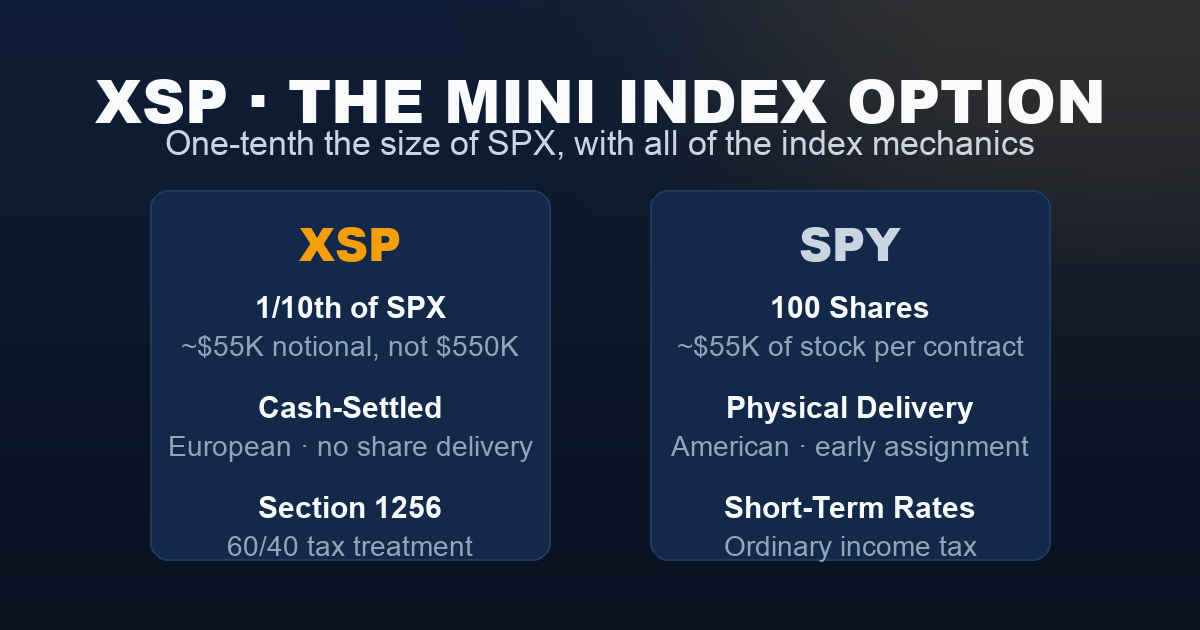
XSP is the Mini-SPX index option — one-tenth the size of SPX, tracking the same S&P 500 index. With SPX near 5,500, one XSP contract controls about $55,000 of notional exposure instead of $550,000. What makes it interesting isn’t the size on its own; it’s that XSP keeps every structural feature that makes SPX attractive to sellers: cash settlement, European exercise, and Section 1256 tax treatment. SPY offers similar notional, but delivers 100 shares, can be assigned early, and is taxed at ordinary short-term rates. The one real cost of XSP is liquidity — the order book is materially thinner than either SPX or SPY, and that shows up in the spread you pay.
What Is XSP?
XSP is a cash-settled index option on the S&P 500, listed by Cboe, sized at 1/10th the value of the standard SPX contract. The index it tracks is identical — XSP’s underlying value is simply SPX divided by ten. If SPX is at 5,500, XSP is at 550.
That last number is what makes the comparison natural. XSP and SPY trade at roughly the same level, because SPY is itself designed to track about 1/10th of the S&P 500 index. A trader looking at a 550 strike sees nearly the same number on both products, which means position sizing translates almost one-for-one — while the contract mechanics underneath are completely different.
XSP vs SPY vs SPX: The Comparison
| XSP | SPY | SPX | |
|---|---|---|---|
| Underlying | S&P 500 index ÷ 10 | SPDR S&P 500 ETF | S&P 500 index |
| Approx. notional | ~$55,000 | ~$55,000 | ~$550,000 |
| Settlement | Cash | 100 shares | Cash |
| Exercise style | European | American | European |
| Early assignment | Impossible | Possible | Impossible |
| Tax treatment | Section 1256 (60/40) | Ordinary short-term | Section 1256 (60/40) |
| Dividend risk | None | Ex-div assignment risk | None |
| 0DTE availability | Every trading day | Every trading day | Every trading day |
| Liquidity | Thin | Deepest in the market | Very deep |
| Typical bid-ask | Wider | Penny-wide | Tight relative to size |
The pattern to notice: XSP matches SPX in every column except size and liquidity, and matches SPY only in size. Every structural advantage that makes index options attractive to a systematic seller — no early assignment , no share delivery , 60/40 tax treatment — comes along at one-tenth the ticket.
Why XSP Exists
Contract size is the practical barrier to trading SPX. A single 50-point-wide SPX credit spread carries $5,000 of max risk before credit. For a $25,000 account, one contract is 20% of the account on a single position — which forces a choice between trading SPX at a size that’s genuinely reckless or giving up on index mechanics entirely.
XSP dissolves that choice. The same 50-point-wide structure on XSP (5 points wide in XSP terms) carries $500 of max risk. A $25,000 account can hold a sensible number of them, scale in and out, and still get cash settlement and 60/40 taxes. It’s the product that lets a smaller account run an index approach rather than an ETF approach.
XSP Tax Treatment
XSP options qualify for Section 1256 treatment: 60% of every gain is taxed at the long-term capital gains rate and 40% at the short-term rate, regardless of how long the position was held. A contract opened at 9:35 AM and closed at 2:15 PM the same day receives the same 60/40 split as one held a year.
This is the difference that compounds hardest for an active trader. SPY options are taxed as ordinary short-term gains — a same-day SPY trade is fully short-term income at your marginal rate. XSP, being an option on a broad-based index rather than on a security, lands in the Section 1256 bucket alongside SPX, NDX, RUT and VIX. For someone in a high bracket trading frequently, that gap is on the order of ten percentage points of effective rate on the same dollars of profit.
Two consequences worth knowing. Section 1256 positions are marked to market at year end — open positions are treated as if closed on December 31 for tax purposes, so unrealized gains are taxed in the year they accrue. And 1256 losses can be carried back three years against prior 1256 gains, an option ordinary capital losses don’t have. Both apply to XSP exactly as they apply to SPX.
How XSP Settles
XSP is cash-settled and European-style, with PM settlement. In-the-money contracts pay the intrinsic difference in cash — no shares change hands, no assignment notice arrives, and nothing carries into the next session.
The practical shape of that: a short 550 XSP call that settles at 552.40 produces a debit of 2.40 × $100 = $240 per contract, and the position is gone. The equivalent SPY position would have delivered a short 100-share position at $550 — $55,000 of stock, held overnight, with whatever gap risk the next open brings.
Because XSP is PM-settled on every listing, there’s no AM-settlement trap to navigate. That’s a small but real simplification versus SPX, where the third-Friday monthly settles on the Friday opening SET print while everything else settles at the close.
The Liquidity Problem
This is the honest reason XSP hasn’t displaced SPY, and it deserves more than a footnote.
XSP’s daily volume is a fraction of SPX’s and a rounding error against SPY’s. Thin books produce wider bid-ask spreads, and on a small contract a wide spread is a large percentage cost. If a 5-point-wide XSP spread should be worth $1.70 and the market is $1.55 bid / $1.85 ask, you’re giving up a meaningful share of the credit before the trade has done anything. On SPY, the same structure quotes penny-wide.
That cost is not trivial for a high-frequency approach. A systematic seller opening and closing daily pays that spread twice per trade, every trade, and slippage of that magnitude can consume a substantial share of an edge that’s already measured in modest percentages. Limit orders and patience help. They don’t make the book deeper.
The realistic assessment: XSP works well for a trader placing a handful of positions with room to work the order, and works poorly for anyone who needs to get filled instantly at the mid. Check the quoted spread on the actual strikes you intend to trade before committing to the product — the headline advantages are real, but they can be eaten by execution.
Which One Should You Trade?
There’s no universal answer, but the decision tree is short.
Account under roughly $30,000, wants index mechanics: XSP is the argument. It’s the only way to get cash settlement, no assignment risk, and 60/40 taxes at a size a small account can hold responsibly. Accept the wider spreads as the price of entry and trade fewer, more deliberate positions.
Account large enough to size SPX properly: trade SPX. Same mechanics, same tax treatment, dramatically better liquidity, and one ticket instead of ten. The full SPX case applies without the execution tax.
Trading strategies that need shares: SPY, necessarily. The wheel requires assignment to work at all — it’s a share-acquisition strategy wearing an options costume. You cannot run it on an index, because there’s nothing to be assigned.
Trading very frequently, execution-sensitive: SPY or SPX, depending on size. When you’re paying the spread many times a day, the deepest book wins, and XSP’s isn’t it.
Frequently Asked Questions
Is XSP the same as SPY?
No. They trade at similar price levels — both around 1/10th of the S&P 500 index — but that’s where the similarity ends. XSP is a cash-settled European-style index option with Section 1256 tax treatment. SPY is an American-style option on an ETF that delivers 100 shares on assignment and is taxed at ordinary rates.
What is XSP tax treatment?
Section 1256: 60% long-term, 40% short-term, regardless of holding period. XSP is an option on a broad-based index, which puts it in the same tax category as SPX, NDX, RUT and VIX. Positions open at year end are marked to market, and 1256 losses can be carried back three years.
Can XSP options be assigned early?
No. XSP is European-style, so exercise can only occur at expiration. A short XSP leg cannot be assigned early no matter how deep in the money it goes, which means a spread stays intact until expiry and there is no ex-dividend assignment risk.
Is XSP good for 0DTE trading?
Structurally, yes — XSP lists daily expirations, settles PM in cash, and carries no assignment risk. The constraint is liquidity: 0DTE strategies typically involve entering and exiting the same session, so you pay the wider XSP spread twice per trade. It suits a smaller account placing a few deliberate positions more than a high-frequency approach.
Why is XSP volume so low?
Mostly inertia. SPY had a two-decade head start and enormous institutional flow, and options liquidity is self-reinforcing — market makers quote tightest where volume already is. XSP’s advantages are structural and tax-related rather than immediately visible on a chart, so adoption has been gradual rather than sudden.
Related Articles
- SPX vs SPY Options: 4 Key Structural Differences — the parent comparison; every advantage listed there applies to XSP at one-tenth the size.
- Section 1256 Options Tax Treatment — the 60/40 rule in full, including the year-end mark-to-market and the three-year loss carryback.
- Cash-Settled vs Physically Settled Options — why “no shares are delivered” changes the operational risk of a position, not just the paperwork.
- Slippage in 0DTE Options Trading — how bid-ask cost compounds across a high-frequency approach, which is the core argument against XSP.
This content is for educational purposes only. Options trading involves significant risk of loss. Always trade within your risk tolerance.