30-Second Summary
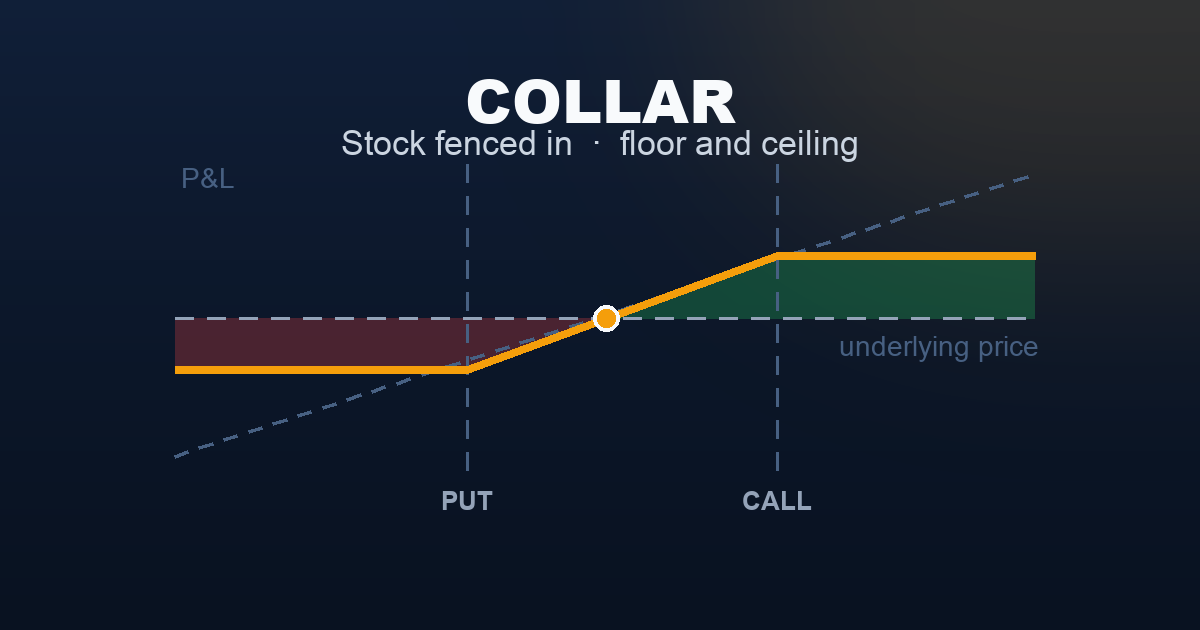
A collar owns stock, sells an OTM call above the current price, and buys an OTM put below it — all in a single structure. The call you sell generates premium that funds the put you buy. When the strikes are chosen so the premiums match, the protection costs nothing net: a zero-cost collar.
The result: a bounded position. Your downside is floored at the put strike. Your upside is capped at the call strike. In between, the position behaves like stock ownership. The collar is not a trade you put on to make money — it is a trade you put on to control risk you already have.
What Is a Collar?
A collar — sometimes called a protective collar, since the whole point is the floor it puts under your shares — is what you get when you run a Covered Call and a Protective Put simultaneously on the same position:
- Own 100 shares of the underlying
- Sell 1 OTM call above the current price (the covered call leg — caps upside, generates credit)
- Buy 1 OTM put below the current price (the protective put leg — floors downside, costs premium)
If the call premium equals the put premium, the two legs cancel out and the collar costs nothing. The covered call pays for the protective put. You’ve converted an open-ended stock position into a defined-range position with no upfront cost.
This is not a coincidence — it’s the design. The collar is the most capital-efficient form of portfolio protection available for a stock position. Rather than paying for a protective put out of pocket, you fund it by agreeing to cap your upside. Whether that trade-off makes sense depends on your conviction about the underlying’s future direction.
The key phrase: you are giving up something you might not need (a large rally) to get something you definitely want (a defined floor).
Setup & Execution
Legs:
- Leg 1: Own 100 shares of the underlying
- Leg 2 (Sell): 1 OTM call above the current price — collects premium, caps upside
- Leg 3 (Buy): 1 OTM put below the current price — pays premium, floors downside
Strike selection and cost structure:
The distance between the strikes and the current price determines both the level of protection and the net cost:
- Zero-cost collar: choose strikes so call premium = put premium. No net cash changes hands. Most common and most practical.
- Net debit collar: buy the put at a higher strike or closer to ATM than the call. Better protection, costs money upfront.
- Net credit collar: sell the call much closer to ATM (or further OTM on the put). Collect premium net but cap upside more aggressively.
For a zero-cost collar, the call strike is usually further OTM than the put strike — because calls typically command more premium than equidistant puts in rising-market environments.
Expiration selection:
- 30–45 DTE: Standard monthly protection, manageable premium and flexibility to roll.
- 90+ DTE: More efficient for longer-term holders — lower annualised premium cost, fewer rolls required.
- LEAPS (1 year+): Used for long-term concentrated positions. Set it and manage at a lower frequency.
SPY Example — Zero-Cost Collar:
Trade:
- Own: 100 shares SPY @ $520
- Sell: 1 SPY $530 Call (30 DTE) for $5.00 = $500 received
- Buy: 1 SPY $510 Put (30 DTE) for $5.00 = $500 paid
- Net cost: $0 (zero-cost collar)
- Breakeven at expiry: $520 (entry price — no net premium to recover)
- Max profit: ($530 − $520) × 100 = $1,000 (SPY ≥ $530)
- Max loss: ($520 − $510) × 100 = $1,000 (SPY ≤ $510)
For a month of completely defined risk, the net cost is zero. The call at $530 caps the upside; the put at $510 floors the downside. The position can neither make more than $1,000 nor lose more than $1,000 at expiration — regardless of how far SPY moves.
Understanding the structure:
| Leg | Action | Premium | |
|---|---|---|---|
| Stock | 100 shares @ $520 | Own | $52,000 deployed |
| Call | $530 strike | Sell | +$500 received |
| Put | $510 strike | Buy | −$500 paid |
| Net | $0 |
The collar’s symmetry in this example — $10 OTM on each side for the same premium — reflects balanced market expectations. In practice, put skew typically means the put costs more for the same distance; you would sell the call closer to ATM to match the premium.
The Payoff Diagram

| SPY at Expiry | P&L |
|---|---|
| $490 | −$1,000 (max loss — floor holds) |
| $510 (put strike) | −$1,000 (max loss) |
| $520 (entry / breakeven) | $0 |
| $530 (call strike) | +$1,000 (max profit) |
| $560 | +$1,000 (max profit — cap holds) |
Below the put strike ($510), the floor activates. Above the call strike ($530), the cap activates. Between the two strikes, the position tracks stock ownership exactly — dollar for dollar. The zero-cost entry means the breakeven is exactly the stock’s entry price.
The Cost of Certainty
The collar is best understood by comparing it to its component strategies and to holding stock alone:
| Collar | Protective Put | Covered Call | Stock Only | |
|---|---|---|---|---|
| Net cost | $0 | −$500 | +$500 | $0 |
| Downside floor | $510 ✓ | $510 ✓ | None | None |
| Max loss | −$1,000 | −$1,000 | ~Unlimited | ~Unlimited |
| Upside cap | $530 | None | $530 | None |
| Max profit | +$1,000 | Unlimited | +$1,000 | Unlimited |
| Theta | Near neutral | Negative | Positive | N/A |
The collar occupies the middle of the table. It shares its defined max loss with the protective put and its upside cap with the covered call — but unlike either standalone strategy, it costs nothing net.
The comparison that matters most is against the standalone protective put: both have the same floor ($510) and the same max loss (−$1,000). But the protective put costs $500 while the collar costs nothing — because the call covers it. The price of free protection is the cap at $530. If you believe the stock will stay below $530 over the next 30 days, the collar is strictly better than the standalone protective put.
The comparison against stock only is stark. Stock ownership has no floor — a 30% decline costs $15,000+. The collar caps that at $1,000, for free, with the only cost being forfeited gains above $530.
How to Set Up a Zero-Cost Collar
A zero-cost collar (also called a costless collar) is a collar where the call premium you collect exactly funds the put premium you pay, so the hedge costs nothing out of pocket. Getting there is a strike-selection exercise, and it takes one more step than most descriptions admit.
The method, in order:
- Pick the put strike first. This is the decision that matters — it’s your floor. Ask how much of a drawdown you’re willing to absorb before protection kicks in, and set the put there. A 2% floor and a 10% floor are entirely different trades.
- Price that put. Say SPY is at $520 and the 30-day $510 put quotes $5.00. That’s your budget: $500.
- Find the call strike that pays for it. Walk up the call chain until you find the strike trading near $5.00. Because of skew, that call will usually sit further from the money than the put.
- Check what the cap costs you. If the funding call lands at $530, you’ve capped a 1.9% gain. If it lands at $525, you’ve capped less than 1%, and the collar may be giving up more than it’s protecting.
- Adjust and repeat. If the cap is too tight, lower the put strike — a cheaper put needs a cheaper call, which sits further out. Protection and upside trade against each other on a single dial.
The 0.30 / 0.30 Delta Collar
A common shorthand is to sell the 0.30-delta call and buy the 0.30-delta put — matching by delta rather than by dollar. It’s a clean rule and it approximately balances the probabilities on each side: roughly a 30% chance of finishing beyond either strike.
What it does not reliably do is produce zero cost. Equity index puts carry persistent skew — the 0.30-delta put is bid higher than the 0.30-delta call because demand for downside protection structurally exceeds demand for upside. On SPY in a normal vol regime, matching deltas usually leaves a small net debit, not a clean zero.
There are three honest ways to handle that:
- Accept the small debit. Pay $0.40 net for a delta-symmetric hedge and stop optimizing. Cleanest option for most holders.
- Sell a closer call. Move to the 0.35-delta call to raise the credit. You reach zero cost, and you cap upside sooner.
- Buy a cheaper put. Move to the 0.25-delta put. You reach zero cost, and your floor sits lower.
“Zero cost” is a cash-flow description, not a free lunch. The premium is paid either way — in dollars, in forfeited upside, or in a lower floor. Choosing which is the actual decision.
Collar Variations
- Put spread collar. Instead of a single long put, buy a put spread — long the $510, short the $490. The short put reduces the hedge cost (making zero-cost easier to reach with a further-out call), but the protection stops at $490. Below that, you’re unhedged again. Useful when you’re guarding against an ordinary correction rather than a crash.
- Net credit collar. Sell the call close enough to ATM that it more than pays for the put. You get paid to hedge, and the upside cap tightens accordingly. This is a collar that has stopped being a hedge and started being an income trade.
- Synthetic collar. The same payoff assembled without holding the shares — long call plus short put at the floor strike replicates the stock exposure, and the structure collapses into a vertical spread. Mathematically equivalent at expiration; different margin treatment and no dividends.
- Rolling collar. Rather than a single expiration, run 30–45 DTE collars continuously, rolling each cycle. This is how the structure is actually used by long-term holders — as a standing policy, not a one-off trade.
Collar vs Protective Put
The two strategies share a floor, so the choice comes down to what you pay for it.
| Collar | Protective Put | |
|---|---|---|
| Cost | ~$0 net | Full put premium ($500) |
| Downside floor | $510 | $510 |
| Upside | Capped at $530 | Unlimited |
| Best when | You expect flat-to-modest gains | You expect a large rally but want insurance |
| Ongoing drag | None | Premium bleeds every cycle |
The protective put keeps the whole upside and charges you for it every single expiration — over a year of rolling 30-day puts, that drag compounds into a serious number. The collar hands over the tail of the upside instead of cash.
For a concentrated position you can’t sell — restricted stock, a large unrealized gain you don’t want to realize — the collar is usually the right structure, because the cash cost of perpetual put buying is the thing that makes hedging unsustainable. For a position you’re genuinely bullish on, the cap is too expensive and the protective put earns its premium.
Understanding the Greeks
A symmetric zero-cost collar — equidistant strikes, matched premiums — has near-neutral Greeks from the options legs. This is one of its most useful properties.
Net Delta (~+0.30 to +0.45): Stock contributes +1.0 delta. The short call subtracts roughly −0.35 delta (you’re short a call with delta ~0.35). The long put subtracts roughly −0.30 delta (you’re long a put with delta ~−0.30, contributing negatively). Net delta is approximately +0.35 to +0.45 — still positively directional, but significantly less than naked stock ownership. The position participates in about 35–45% of the stock’s daily move.
Net Theta (near zero): The short call earns theta; the long put pays theta. For symmetric, equidistant strikes with matched premiums, these approximately cancel. Unlike a naked protective put (which bleeds theta daily), the collar has almost no daily time decay cost. This is the practical advantage of funding the put with a call: the protection doesn’t drain your account each day.
Net Vega (near zero): The short call is short vega (hurts from rising IV); the long put is long vega (benefits from rising IV). For symmetric strikes, these roughly cancel. The collar is largely indifferent to volatility changes — another practical advantage for long-term holders who don’t want to manage vega risk.
Net Gamma (near zero for symmetric collars): The short call’s negative gamma and the long put’s positive gamma offset each other for equidistant strikes. The collar behaves almost like a linear, bounded stock position with minimal optionality curvature. In practice, slight asymmetries in the strikes will introduce small positive or negative gamma, but this is rarely a significant management consideration.
The overall picture: a symmetric zero-cost collar acts like a capped, floored stock position with almost no option Greeks to actively manage. This is why it’s popular for long-term holders — you get defined risk without ongoing theta drain, vega exposure, or gamma surprises.
Trade Management & Adjustments
Rolling the call: As expiration approaches with SPY above the call strike ($530), the call will be exercised and your shares called away. If you want to keep the shares, roll the call forward — buy back the expiring $530 call and sell a new call at a higher strike and/or later expiration, collecting additional premium. This effectively ratchets your upside cap higher while maintaining protection.
Rolling the put: If SPY declines toward the put strike ($510), you can roll the put — sell the existing put and buy a new one with a lower strike and/or later expiration. Rolling the put down and out maintains the collar structure if you want to stay in the trade, but reduces the floor level. Only roll down if you can afford the lower floor.
Lifting the call (partial unwind): If you become more bullish mid-trade, you can buy back the short call to remove the upside cap while keeping the protective put. The put becomes a standalone protective put again, just as if you’d bought it originally — though you’ll pay the current call price to close it, which may be more than the credit you received if SPY has rallied.
Closing the full collar: If you decide to sell the stock, close all three legs simultaneously: sell the shares, buy back the short call, and sell the long put. Most brokers support multi-leg orders that handle this as a single transaction.
What to avoid:
- Collaring a stock you’re no longer willing to hold. The collar defers the decision to sell — it doesn’t eliminate the underlying position risk.
- Setting the put strike too far OTM for a “zero cost” collar by also setting the call too close to ATM. This produces a cheap collar but aggressively caps a stock you presumably hold because you’re bullish on it.
- Ignoring dividend dates. SPY calls are American-style — the buyer can exercise early before ex-dividend to capture the dividend. If your covered call is exercised early, you lose the dividend and your collar’s structure unwinds.
Real-World Example
The trade: A trader holds 100 shares of SPY bought at $522. A major election is scheduled in 28 days, introducing significant near-term uncertainty. The trader is long-term bullish but wants to protect the position through the event without selling. VIX is low at 14.2, making protection relatively cheap.
- Own: 100 shares SPY @ $522
- Sell: 1 SPY $534 Call (30 DTE) for $4.50 = +$450
- Buy: 1 SPY $510 Put (30 DTE) for $4.50 = −$450
- Net cost: $0
- Max profit: ($534 − $522) × 100 = +$1,200 (SPY ≥ $534)
- Max loss: ($522 − $510) × 100 = −$1,200 (SPY ≤ $510)
Scenario A — Protection triggered (SPY falls):
The election produces an unexpected result. SPY falls from $522 to $488 over the 30 days.
| With Collar | Without Collar | |
|---|---|---|
| Stock P&L | −$3,400 | −$3,400 |
| Short $534 call | Expired worthless | — |
| Long $510 put | +$2,200 (intrinsic $22 × 100) | — |
| Net P&L | −$1,200 (floor) | −$3,400 |
The collar absorbed $2,200 of a $3,400 loss. The floor held exactly as designed.
Scenario B — Cap triggered (SPY rallies):
The election is resolved smoothly. Risk assets rally. SPY moves from $522 to $556.
| With Collar | Without Collar | |
|---|---|---|
| Stock P&L | +$1,200 (capped, shares called at $534) | +$3,400 |
| Short $534 call | Exercised — shares sold at $534 | — |
| Long $510 put | Expired worthless, −$450 | — |
| Net P&L | +$1,200 (capped) | +$3,400 |
The collar cost $2,200 in missed upside. The protection that wasn’t needed consumed gains.
These two scenarios define the collar’s character: it narrows the outcome to a defined range. Whether that’s worth it depends entirely on how much uncertainty you’re willing to accept.
When to Use This Strategy
Best conditions:
- You hold a meaningful stock position through a specific, time-limited risk event (earnings, election, economic data, regulatory decision)
- VIX is low — protection is cheap, making the zero-cost collar achievable with minimal upside sacrifice
- You have a large unrealised gain you cannot or don’t want to realise yet (tax considerations, holding period)
- You are comfortable giving up some upside in exchange for sleep-at-night certainty
Avoid when:
- You are strongly bullish — the call cap limits the very outcome you’re positioning for
- The spread between available strikes is too wide to achieve a zero-cost collar without setting the call far too close to the current price
- You’re applying it mechanically every month on a position you’d be better off simply selling
Ideal VIX level: 12–18. Lower VIX makes the zero-cost collar easier to structure — more premium from the call can fund a closer put. Above 20, both puts and calls are more expensive, but the asymmetric nature of put skew means achieving zero-cost may require selling a call that’s uncomfortably close to ATM.
Strategy Ladder — Next Steps
Came from: Covered Call + Protective Put — the collar is exactly these two strategies stacked on the same position. If you’ve read both, you’ve already understood the collar’s components.
This completes Level 2. You now understand single-leg strategies, all four vertical spreads, the naked short put, and the collar. The building blocks for everything at Level 3 are in place.
At Level 3:
- Iron Condor — sell a bull put spread below the market and a bear call spread above it simultaneously. Profit from range-bound markets with defined risk on both sides. The core strategy on this site.
- Iron Butterfly — tighten the iron condor until both short strikes share the same price. Higher credit, narrower profit zone.
- Poor Man’s Covered Call — use a deep ITM LEAPS call as a stock substitute to write covered calls with far less capital.
- Calendar Spread — exploit the difference in time decay between two expirations on the same strike.
→ Level 3 — Advanced Strategies
This content is for educational purposes only. Options trading involves significant risk of loss. Past performance is not indicative of future results.