30-Second Summary
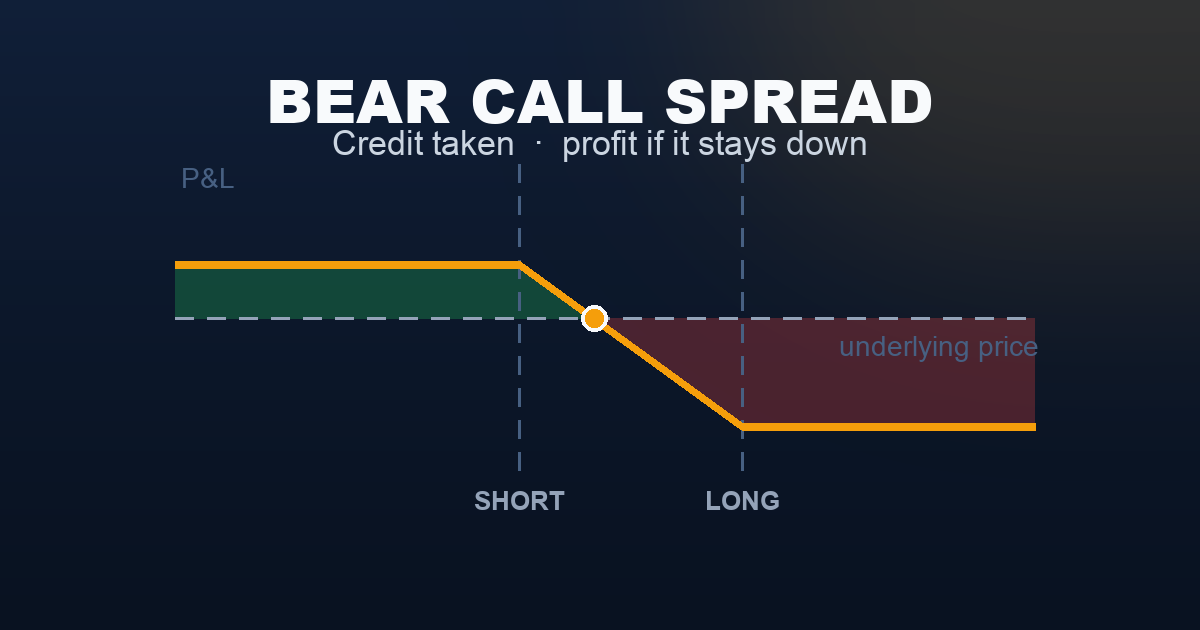
A bear call spread sells a call at a lower strike and buys a call at a higher strike — same underlying, same expiration. You receive a net credit upfront. If the underlying stays below the short strike at expiration, both calls expire worthless and you keep the full credit. If it rallies through the short strike and keeps going, you lose — but only up to the defined maximum, capped by the long call you bought.
This is a seller’s strategy. Theta works in your favour every day the underlying fails to rally. You don’t need to be right about direction — you just need the underlying not to move strongly against you. The trade-off: probability is on your side but your maximum loss is larger than your maximum profit.
What Is a Bear Call Spread?
A bear call spread — also called a vertical call credit spread, or a short call vertical in broker shorthand — combines two calls on the same underlying with the same expiration:
- Sell 1 call at a lower strike (the short leg — this is where the premium comes from)
- Buy 1 call at a higher strike (the long leg — this caps your maximum loss)
You receive the net difference between the two premiums as a credit. That credit is your maximum profit if both calls expire worthless.
Without the long call, you’d be selling a naked call — unlimited loss potential if the underlying rallies sharply. The long call at the higher strike acts as a ceiling on your loss. You pay a small amount for that protection, reducing your net credit slightly. In exchange, you gain a defined worst-case outcome: no matter how far the underlying rallies, your loss stops at the spread width minus the credit received.
The word bear refers to the directional bias: you profit most when the underlying is flat or falling. The word spread reflects the two-leg structure. The word credit distinguishes it from the bull call spread, which is a debit spread requiring an upfront payment.
The key phrase: you profit by being right about what doesn’t happen. SPX doesn’t have to fall — it just has to not rally past your short strike by expiration.
Setup & Execution
Legs:
- Leg 1 (Sell): 1 call at the lower strike — the core of the trade, where the credit comes from
- Leg 2 (Buy): 1 call at the higher strike — the protection that caps your loss
Both legs: same underlying, same expiration.
Strike selection:
- Short strike OTM: Sell above the current price. The further OTM, the lower the credit but the higher the probability of keeping it. Most traders sell at the 20–35 delta level for a balance of premium and probability.
- Long strike further OTM: Typically 25–50 points above the short strike on SPX. Wider spreads offer more premium but proportionally larger max loss. Narrower spreads are cheaper to hedge but collect less.
- Key ratio: aim to collect at least 20–25% of the spread width as credit. Collecting $10 on a $50-wide spread = 20% — the minimum threshold for reasonable risk/reward.
Expiration selection:
- 21–45 DTE: The sweet spot. Theta is accelerating, there’s time for the thesis to develop, and the position isn’t exposed to gamma risk yet.
- 0–14 DTE: High risk. Negative gamma can accelerate losses rapidly if SPX approaches the short strike near expiry. Not recommended for this strategy as a primary setup.
- 7 DTE (for income rolling): Used by systematic sellers who roll positions frequently — accept lower credit in exchange for faster theta decay.
SPX Example — Entry:
Trade:
- Sell: 1 SPX 7,550 Call (30 DTE) for $22.00 = $2,200 received
- Buy: 1 SPX 7,600 Call (30 DTE) for $7.00 = $700 paid
- Net credit: $15.00 per contract = $1,500 received
- Max profit: $1,500 (if SPX ≤ 7,550 at expiry)
- Breakeven at expiry: $7,550 + $15.00 = $7,565
- Max loss: ($7,600 − $7,550 − $15.00) × 100 = $3,500
For maximum profit, SPX must close at or below $7,550 at expiration — it can stay flat, drift lower, or rally up to 50 points as long as it doesn’t breach the short strike.
Breaking down the net credit:
| Short 7,550 Call | Long 7,600 Call | Net | |
|---|---|---|---|
| Premium | +$2,200 (received) | −$700 (paid) | +$1,500 |
| Max gain | Unlimited exposure | Caps loss at 7,600 | $1,500 |
| Max loss | Unlimited (naked) | Limited to spread | $3,500 |
The long call at 7,600 costs $700 but converts unlimited risk into a defined $3,500 maximum loss. That $700 is not waste — it is the price of certainty.
The Payoff Diagram

| SPX at Expiry | P&L |
|---|---|
| 7,400 | +$1,500 (max profit) |
| 7,500 (entry) | +$1,500 (max profit) |
| 7,550 (short strike) | +$1,500 (max profit) |
| 7,565 (breakeven) | $0 |
| 7,580 | −$1,500 |
| 7,600 (long strike) | −$3,500 (max loss) |
| 7,650 | −$3,500 (max loss) |
Above the short strike ($7,550), profit declines linearly with each point SPX rises. Above the long strike ($7,600), the loss is flat — the long call absorbs all additional losses. Below $7,550, both calls expire worthless and you keep the full credit regardless of how low SPX goes.
Notice the shape: it is the mirror image of the bull call spread. Profit on the left, loss on the right.
The Defined-Risk Advantage
The bear call spread is best understood by comparing it to the alternative: selling the call naked.
| Bear Call Spread | Naked Short Call | |
|---|---|---|
| Net credit received | $1,500 | $2,200 (no long call cost) |
| Max profit | $1,500 | $2,200 |
| Max loss | $3,500 (defined) | Unlimited |
| Margin required | ~$3,500 (spread width − credit) | Typically $15,000–$30,000+ |
| Theta | Positive — earns each day | Positive — earns each day |
| Probability of max profit | ~65–70% | ~65–70% (same short strike) |
Selling the naked call collects $700 more in premium but removes all loss protection. A sharp SPX rally to 7,700 produces an enormous loss on the naked call versus a capped $3,500 on the spread. That $700 of additional premium is not worth the unlimited tail risk for most traders.
The margin difference is especially significant. A naked short call on SPX can require $15,000–$30,000+ in margin collateral. The spread requires only ~$3,500 (the max loss). The same capital can run four or more spread positions versus one naked call, with defined and distributed risk across each.
This is why bear call spreads dominate over naked calls in well-managed options books. The small reduction in premium collected is a rational price for the enormous reduction in tail risk and margin cost.
Understanding the Greeks
The bear call spread’s Greeks are the net of both legs — short call minus long call.
Net Delta (negative, ~−0.15 to −0.25): You sold the lower-strike call (higher delta, e.g. ~0.30) and bought the higher-strike call (lower delta, e.g. ~0.15). Net delta is negative — the position loses value as SPX rises and gains as it falls or stays flat. As SPX rallies through the short strike, the net delta becomes more negative and losses accelerate. Above the long strike, both calls are deep ITM, deltas converge, and net delta approaches zero — the position is locked at max loss.
Net Theta (positive — your friend): As time passes with SPX below the short strike, both calls decay. The short call decays faster (it has more time value at a closer-to-ATM strike), so the net theta is positive — you earn money each day. This is the core advantage of selling premium: you don’t need SPX to move. You need it to not move past your strike. For a 30 DTE spread with $15 credit, net theta might earn $5–$10 per day in decay.
Net Vega (negative — your enemy): Both calls have positive vega, but the short call has more (it’s closer to ATM). The net position has negative vega — rising implied volatility hurts the bear call spread. If VIX spikes from 18 to 28 after entry, the short call becomes significantly more expensive to buy back, generating an unrealised loss even if SPX hasn’t moved much. This is why entering credit spreads during calm, low-VIX environments is riskier than during elevated VIX — there’s more IV expansion potential to hurt you.
Net Gamma (negative — accelerates losses near the short strike): The short call has more gamma than the long call. Net gamma is negative. As expiration approaches with SPX near the short strike ($7,550), the position’s delta swings rapidly and unpredictably. A small rally can produce a large increase in losses. This is the signature risk of negative gamma: everything feels fine until the underlying gets close to the strike in the final days.
Net Rho (negative): Higher interest rates increase call values. The short call’s rho is larger than the long call’s, so the net position has negative rho — rising rates marginally hurt the bear call spread. Negligible for 30 DTE positions.
Trade Management & Adjustments
Taking profits early: Close at 50% of max profit. If you collected $1,500 and the spread is now worth $750 to buy back, close it. You’ve captured half the gain with less time remaining, and the remaining $750 is not worth the gamma risk of holding through the final two weeks. Many systematic sellers close at 50% or 21 DTE, whichever comes first.
Rolling up and out: If SPX rallies toward the short strike ($7,550) but hasn’t breached it, you can roll — buy back the existing spread and sell a new one at a higher strike and/or later expiration. This collects additional credit and extends the profit zone upward. Rolling is only appropriate if you still believe SPX will find resistance. Rolling into a strongly trending market can result in chasing losses.
Defending the breach: If SPX closes above the short strike, the spread has moved against you. Options at this point:
- Close immediately and accept the loss — the clearest choice if the thesis is broken
- Roll to a wider spread at a higher strike, collecting more credit but increasing max risk
- Hold to expiration if SPX is between the short and long strikes and you believe the rally will stall
Never hold a breached bear call spread without a plan. The most expensive mistakes come from hoping a rally reverses without taking action.
What to avoid:
- Entering a bear call spread in a strongly trending bull market. Credit spreads are for ranging or modestly directional environments, not for fighting a trend.
- Selling the short strike too close to the current price for marginal extra credit. A 10-delta short strike (far OTM) may collect only $200 for a $50-wide spread — barely worth the overhead.
- Confusing “the underlying didn’t crash” with “the trade is safe.” A bear call spread loses money on rallies, not crashes. Stay aware of your directional exposure.
Real-World Example
The trade: SPX has been oscillating in a 200-point range for six weeks. A key resistance level sits near 7,550. VIX is slightly elevated, offering reasonable credit. The trader has no strong directional view — they simply don’t expect a breakout above resistance within the next month.
- Sell: 1 SPX 7,550 Call (30 DTE) for $16.00 = $1,600
- Buy: 1 SPX 7,600 Call (30 DTE) for $6.00 = $600
- Net credit: $10.00 = $1,000
- Max profit: $1,000
- Max loss: ($50 − $10) × 100 = $4,000
- Breakeven: 7,560
What happened:
Markets remained range-bound. A brief push to 7,532 on strong retail sales data faded within two days. SPX drifted back and finished at 7,541 at expiration — 9 points below the short strike.
Both calls expired worthless. The full $1,000 credit was kept.
Result: +$1,000 (full max profit)
The trade required no active management, no directional movement, and no dramatic macro event. SPX simply stayed below a level it had already struggled to breach. That’s the bear call spread in ideal conditions: a range-bound market, clear resistance overhead, and time working for you.
The scenario that breaks it: If SPX had instead gapped to 7,610 on unexpectedly strong earnings:
- SPX at expiry: 7,610 (above both strikes)
- Loss: ($50 − $10) × 100 = −$4,000 (max loss)
- The long call capped the loss exactly as designed — no additional damage beyond $4,000 regardless of how far SPX moved above 7,600.
When to Use This Strategy
Best conditions:
- SPX is near or below a known technical resistance level
- You expect a flat or declining market over the next 30 days
- IV is elevated — higher VIX means more credit collected for the same strike distance
- You want to generate income in a neutral or mildly bearish environment without taking unlimited risk
Avoid when:
- The market is in a strong uptrend — credit spreads should not be used to fight momentum
- VIX is very low — the credit collected may not justify the margin tied up
- A known catalyst (FOMC, CPI, earnings season) is within the expiration window that could trigger a sharp rally
Ideal VIX level: 18–30. The higher the VIX, the more credit you collect for the same strike placement. Bear call spreads become especially attractive after a market pullback, when VIX is elevated and resistance overhead is clearly defined — the ideal combination of high premium and statistical edge.
Strategy Ladder — Next Steps
Came from: The Bull Call Spread is the opposite side of this same structure — buy a call spread for a bullish debit position. Understanding both lets you see how the same two-leg call structure can be either offensive or defensive.
The bearish buyer’s alternative: → Bear Put Spread — buy a put spread for a bearish view, pay a debit, get a better risk/reward but lower probability of profit.
The bullish credit spread: → Bull Put Spread — sell a put spread for a bullish view, same credit structure as this trade but on the other side.
Natural progression:
- Combine this bear call spread with a bull put spread → Iron Condor — sell premium on both sides, profit from a range-bound market
- Already running this on the call side and a bull put spread on the put side? That is exactly the iron condor structure
This content is for educational purposes only. Options trading involves significant risk of loss. Past performance is not indicative of future results.