30-Second Summary
A long iron condor — also called a reverse iron condor or debit iron condor — pays a net debit to hold two profit zones — one above the market and one below it. If the underlying makes a large enough move in either direction before expiration, one of the wings becomes profitable and more than recovers the debit paid. If the market stays range-bound, both wings expire worthless and you lose the full debit.
This is a buyer’s strategy. Theta works against you every day. You are long volatility — betting that the market will move more than current option prices imply. The long iron condor is the opposite of the Short Iron Condor : same four strikes, inverted payoff.
What Is a Long Iron Condor?
A long iron condor buys two spreads that bracket the current price:
- Upper wing: A Bull Call Spread above the current price — buy a lower-strike call, sell a higher-strike call
- Lower wing: A Bear Put Spread below the current price — buy a higher-strike put, sell a lower-strike put
You pay a net debit — the combined cost of both spreads. In exchange, you own defined-risk exposure to a large move in either direction. If SPX rallies sharply past the upper long strike, the bull call spread pays out. If SPX falls sharply past the lower long strike, the bear put spread pays out.
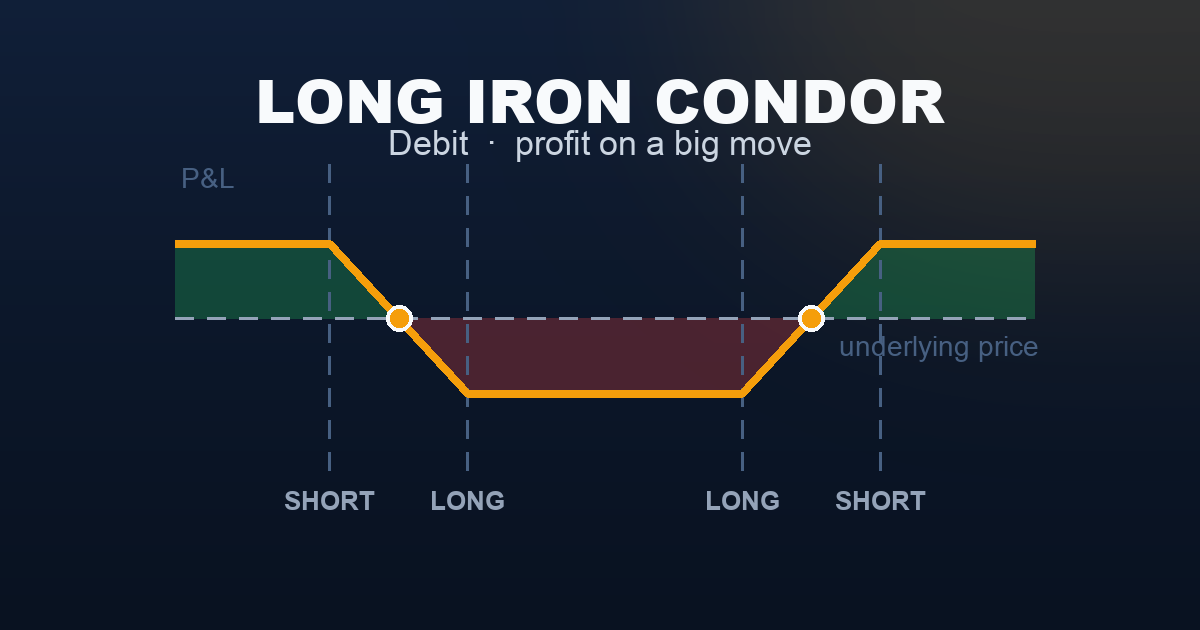
The payoff diagram is the exact mirror image of the short iron condor — an inverted tent. Where the short condor has its profit plateau in the middle and losses on the wings, the long condor has its loss trough in the middle and profits on the wings.
The key question: will the underlying move more than option prices currently imply? If IV is cheap relative to the actual move that materialises, the long condor wins. If the market stays quiet, IV was correctly priced or overpriced and the buyer loses.
Setup & Execution
Legs:
- Leg 1 (Buy): 1 OTM call at the lower call strike — the core of the upper wing
- Leg 2 (Sell): 1 OTM call at the higher call strike — limits the call-side gain, reduces cost
- Leg 3 (Buy): 1 OTM put at the higher put strike — the core of the lower wing
- Leg 4 (Sell): 1 OTM put at the lower put strike — limits the put-side gain, reduces cost
All four legs: same underlying, same expiration.
Strike selection:
- The sold strikes (the inner legs) reduce the net debit at the cost of capping the maximum profit on each wing. Wider spacing between the buy and sell legs on each side = more potential profit, more debit paid.
- The bought strikes (the outer legs) should be placed at levels you genuinely expect the underlying to reach. There is no point buying a wing that would only profit from an extreme, low-probability move.
- Most traders use symmetric strikes equidistant from the current price for a non-directional setup.
Expiration selection:
- 7–21 DTE: The most common window. Close to the event, fast theta decay when the move doesn’t materialise, but enough time for the move to play out if it does.
- 0 DTE: Extreme case. Used for same-day event plays (FOMC day, CPI release). The move either happens today or not. Purely binary.
- 30+ DTE: Rarely useful for a long condor — you pay excessive theta for a slower move. Long condors generally only make sense when a specific catalyst is imminent.
SPX Example — Entry:
Trade:
| Leg | Strike | Action | Premium |
|---|---|---|---|
| Long call | 7,550 | Buy | −$1,400 |
| Short call | 7,600 | Sell | +$550 |
| Long put | 7,450 | Buy | −$1,400 |
| Short put | 7,400 | Sell | +$550 |
| Total | −$1,700 |
- Net debit: $17.00 per contract = $1,700 total paid
- Max profit (either wing): ($50 spread width − $17 debit) × 100 = $3,300
- Upper breakeven: 7,550 + 17 = 7,567
- Lower breakeven: 7,450 − 17 = 7,433
- Max loss: $1,700 (the net debit — when SPX stays between 7,450 and 7,550)
For maximum profit, SPX must close at or beyond 7,600 (upper wing) or at or below 7,400 (lower wing) — a move of at least 100 points (1.33%) from entry.
The Payoff Diagram

| SPX at Expiry | P&L |
|---|---|
| 7,350 | +$3,300 (max profit, lower wing) |
| 7,400 (long put) | +$3,300 (max profit) |
| 7,433 (lower breakeven) | $0 |
| 7,450 (short put) | −$1,700 (max loss) |
| 7,500 (entry) | −$1,700 (max loss) |
| 7,550 (short call) | −$1,700 (max loss) |
| 7,567 (upper breakeven) | $0 |
| 7,600 (long call) | +$3,300 (max profit) |
| 7,650 | +$3,300 (max profit, upper wing) |
The flat loss trough between the short strikes is the signature of the long condor — the zone where the debit is fully lost. The profit wings extend outward from the long strikes in both directions.
Short vs Long: Two Ways to Trade a Condor
The long iron condor is the direct counterpart to the Short Iron Condor . Same four strikes and expiration. Opposite positions and opposite payoffs.
| Short Iron Condor | Long Iron Condor (This Article) | |
|---|---|---|
| Structure | Sell condor — receive credit | Buy condor — pay debit |
| Net premium | +$1,700 collected | −$1,700 paid |
| Profit requires | SPX stays inside the range | SPX breaks outside the range |
| Max profit | $1,700 | $3,300 |
| Max loss | $3,300 | $1,700 |
| Theta | Strongly positive | Strongly negative |
| Vega | Negative — hurt by rising IV | Positive — benefits from rising IV |
| Ideal condition | Calm, range-bound market | Volatile, pre-event, large move expected |
The short condor sells uncertainty. It earns when the market does nothing. Most months, markets are stable — which is why systematic sellers typically run the short version.
The long condor buys uncertainty. It earns when the market surprises. Before known binary events — earnings, FOMC decisions, elections — the market often underprices the potential move. A long condor placed before such an event, when IV is still relatively low, can pay off handsomely if the event triggers a sustained directional move.
The key insight: a long condor on the same strikes as a short condor produces a combined position with zero risk — they cancel exactly. You are always on one side or the other.
Understanding the Greeks
Net Delta (near zero when balanced): Like the short condor, a symmetric long condor starts with near-zero net delta. As SPX moves toward either wing, net delta increases in the direction of the move — the position accelerates toward profit. This is the fundamental appeal: you don’t need to pick a direction.
Net Theta (strongly negative — your biggest cost): Every day that passes without SPX moving is money lost. For a 14 DTE long condor paying $1,700, net theta might cost $50–$100 per day. This is why the long condor is only viable around specific catalysts — the theta drain makes long-duration holding prohibitively expensive. Enter close to the event, exit as soon as a wing pays off.
Net Vega (strongly positive — your greatest ally): The long condor benefits from rising implied volatility. If VIX spikes after entry — even if SPX hasn’t moved yet — the long condor gains value as both bought options become more expensive. This is the double tailwind in a volatility event: SPX moves (intrinsic gain) plus IV expands (extrinsic gain). The best long condor entries come when IV is low before an event that could spike it.
Net Gamma (positive — accelerates profits on large moves): Positive gamma means the long condor gains value faster as the underlying approaches a wing. A swift, large move produces outsized profits relative to a slow drift — exactly the scenario you want from a volatility event. Gamma also makes the position more dynamic: it benefits from being active, not passive.
Net Rho (near zero): The two sides approximately offset. Negligible.
Trade Management & Adjustments
Take profits immediately when a wing pays off: If SPX gaps through one of the long strikes and the wing reaches 50–75% of its maximum value, close the entire condor. Don’t hold for the full $3,300 — theta and potential mean-reversion can take back gains quickly after a large move. The goal is to capture the event-driven surge, not to hold through recovery.
Cut losses if the catalyst passes without a move: If the event that motivated the trade occurs and SPX barely moves, the long condor will lose most of its value to theta in the days that follow. Close the position after the event regardless of direction. A $1,200 loss today becomes a $1,700 loss if you hold to expiration hoping for a second event.
Avoid holding to expiration: The long condor near expiration with SPX between the short strikes is in maximum loss territory with rapidly accelerating theta. There is no recovery without a large move — and a large move this close to expiry is less probable every hour. Exit early, preserve capital.
What to avoid:
- Entering the long condor when IV is already elevated. You’re paying inflated premiums for a move that may be already priced in. The long condor works when IV is cheap relative to the expected event magnitude.
- Using wide short-to-long strike spacing to chase a higher max profit. Wider spacing means higher debit and a smaller probability of the move reaching the long strikes.
- Running multiple long condors on uncorrelated underlyings. The long condor’s edge comes from specific, identifiable catalysts — not from broad portfolio exposure.
Real-World Example
The setup: A Federal Reserve meeting is scheduled in 6 days. The market is calm at VIX 15.2 — historically low for a Fed week. The trader expects a significant policy surprise but doesn’t know the direction. They enter a long iron condor to profit from a large move in either direction.
- Buy SPX 7,550 Call + Sell SPX 7,600 Call: debit $8.00 = $800
- Buy SPX 7,450 Put + Sell SPX 7,400 Put: debit $8.00 = $800
- Total debit: $16.00 = $1,600
- Breakevens: 7,434 and 7,566
- Max profit (either wing): ($50 − $16) × 100 = $3,400
What happened:
The Fed delivered an unexpected 50bp rate cut — larger than consensus expected. SPX gapped sharply higher, from 7,504 to 7,596 on the day of the announcement. By the following morning, SPX was at 7,618 — above the long call strike of 7,600.
At SPX 7,618:
- Bull call spread (7,550/7,600): long call = $68 intrinsic, short call = $18 intrinsic → spread value = $50 (max) → P&L = ($50 − $8) × 100 = +$4,200
- Bear put spread: both puts OTM → −$800
- Net P&L: +$4,200 − $800 = +$3,400 (max profit)
The trader closed the position the morning after the Fed meeting, capturing the full max profit in 7 days.
The losing scenario (same trade, different Fed outcome):
If the Fed had delivered a 25bp cut exactly as expected, SPX might have rallied modestly to 7,530 — still within the short strikes. After 8 days of theta drain:
- Both spreads near worthless
- Net P&L: −$1,600 (max loss)
The entire debit is lost. The event happened but wasn’t large enough. This is the core risk of the long condor: being right about “there will be a move” but wrong about “the move will be large enough.”
When to Use This Strategy
Best conditions:
- A specific, identifiable catalyst is imminent — FOMC decision, CPI release, major earnings, election results
- VIX is relatively low before the event — option premiums haven’t yet priced in the expected volatility spike
- You genuinely don’t know the direction of the move — if you have a directional view, a vertical spread or naked long option is more capital-efficient
- The expected move is larger than the breakeven distance the condor requires
Avoid when:
- VIX is already elevated — you’re paying inflated premiums for a move that may already be priced in
- No specific catalyst is identified — without a reason for a large move, you’re just paying theta to wait
- You’re trying to hold through multiple events — the theta drain makes long condors expensive to hold for more than one or two weeks
Ideal VIX level: Below 18. The lower the VIX, the cheaper the debit — and the bigger the potential payout if the event triggers a volatility spike. Above 20, the debit becomes expensive relative to the possible gain, and the probability of a large enough move to reach the long strikes decreases.
Strategy Ladder — Next Steps
The opposite trade: → Short Iron Condor — sell the same four strikes, collect credit, profit if SPX stays range-bound. Everything about this trade in reverse.
Uncapped versions:
- Want unlimited upside on a big move? → Long Straddle — buy an ATM call and put, no cap on profit in either direction. Higher cost, no wing to limit the debit.
- Want a directional big-move bet? → Long Strangle — buy an OTM call and OTM put, cheaper than a straddle, still uncapped.
The tighter version: → Long Iron Butterfly — move both short strikes to the ATM level. Cheaper debit, but SPX must move significantly in either direction to reach the long strikes. Extreme version of the long condor.
This content is for educational purposes only. Options trading involves significant risk of loss. Past performance is not indicative of future results.