30-Second Summary
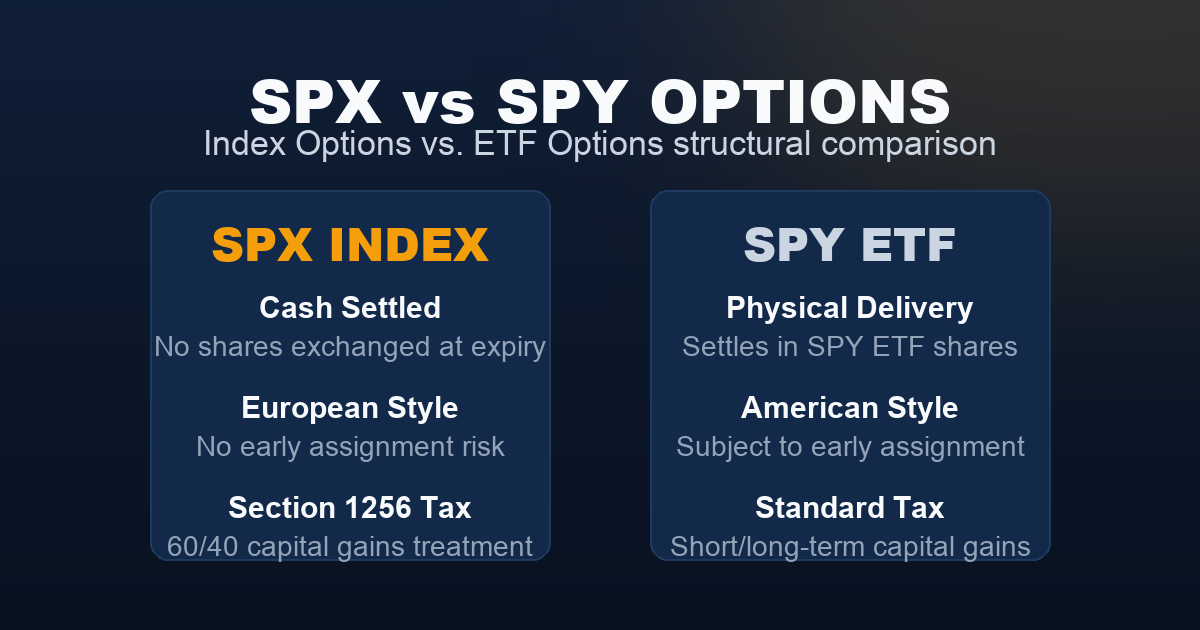
While SPX (S&P 500 Index) and SPY (S&P 500 ETF) options track the exact same market basket, they are fundamentally different financial instruments. SPX options are European-style, cash-settled index contracts that qualify for favorable Section 1256 tax treatment (60/40 capital gains splits) and carry zero early assignment risk.
In contrast, SPY options are American-style, physically delivered ETF contracts that settle in shares of SPY stock, can be exercised at any time before expiration, and are taxed under standard short-term and long-term capital gains rules. For short-term and systematic option sellers—especially those trading same-day (0DTE) expirations—SPX options offer major structural advantages.
Why Compare SPX and SPY Options?
At first glance, SPX and SPY options seem to do the same job. Both allow you to trade the movement of the S&P 500, the benchmark index for the U.S. stock market. If the S&P 500 rallies, call options on both instruments rise, and put options fall.
However, the structural pipes behind these contracts are entirely different. SPX is a direct index, representing a mathematical value of the 500 component stocks. You cannot buy shares of SPX itself. SPY is an Exchange-Traded Fund (ETF) managed by State Street that actually buys and holds the 500 component stocks to mimic the index.
Because one is an index and the other is a stock, options written on them follow different tax rules, different exercise conventions, and different settlement mechanics. Understanding these mechanics is the difference between a clean, optimized trade and an unexpected tax bill or assignment surprise.
SPX vs SPY Options: The 4 Key Differences
The structural divide between index options and ETF options boils down to four main categories: taxes, settlement, exercise style, and contract size.
1. Section 1256 Tax Treatment (60/40 Rule)
Are SPX options Section 1256 contracts? Yes, SPX options qualify as Section 1256 contracts under IRS rules because they are cash-settled index options. This designation provides a significant tax advantage: regardless of how long you hold the options (even if only for seconds), all realized gains are taxed at a split rate of 60% long-term and 40% short-term capital gains.
For a short-term trader or systematic premium seller, this tax treatment is highly impactful. Under standard tax rules, short-term capital gains (assets held for less than a year) are taxed at your ordinary income rate, which can be as high as 37%. Long-term capital gains max out at 20%.
By blending the two, a Section 1256 contract effectively lowers your tax rate. For example, if you are in the 32% ordinary income tax bracket:
- SPY Option Gains: Taxed entirely at your ordinary rate of 32%.
- SPX Option Gains: Taxed at a blended rate—60% at the long-term rate (typically 15% for this income level) and 40% at the ordinary rate (32%). Your effective tax rate drops to 21.8%.
This is a savings of over 10% on your net trading gains, which dramatically improves the mathematical expectancy of your strategy over hundreds of trades. The full mechanics — mark-to-market at year end, Form 6781, the missing wash-sale rule — are covered in our dedicated Section 1256 tax treatment guide .
2. Cash Settlement vs. Physical Stock Delivery
Are SPX options cash-settled? Yes, SPX options are cash-settled index options , meaning no underlying shares are exchanged when the options expire. Instead, any options that expire in-the-money (ITM) are settled by transferring cash directly into the trader’s account, representing the difference between the strike price and the settlement value.
Conversely, SPY options are physically settled. When a SPY option expires ITM, the writer must deliver (or buy) 100 shares of the SPY ETF per contract.
This creates a sharp difference in operational risk at expiration:
- SPY Expiration Risk: If you sell a SPY credit spread and the market moves past your short strike at the close, you will be assigned 100 shares of SPY stock per contract. If you do not have the capital to carry $50,000+ of stock per contract, your broker will issue a margin call and force-liquidate the position.
- SPX Expiration Risk: If your SPX spread expires ITM, the cash difference is calculated, your account is debited or credited, and you wake up the next morning with a clean ledger. There is no stock to manage, no inventory to sell, and no overnight gap risk on assigned shares.
3. European Style vs. American Style Exercise
Are SPX options European style? Yes, SPX options are European-style options , meaning they can only be exercised at their expiration date. Option sellers cannot be assigned early, allowing credit spreads and complex strategies to be held through intraday moves without fear of the position being broken apart.
SPY options are American-style options. The buyer of a SPY option can choose to exercise it at any point during market hours on any day prior to expiration.
For credit sellers (such as iron condor or vertical spread traders), American-style options introduce the risk of early assignment. If the underlying stock moves against your position, the buyer of the option you sold can exercise their right, forcing your broker to assign you the stock.
This breaks your defined-risk structure. When you are assigned on the short leg of a spread early, you are left holding a large, directional, unhedged stock position overnight, while your long option remains unexercised. In SPX, early assignment is structurally impossible. The trade runs exactly to expiration, and the defined-risk wings protect you completely.
4. Contract Multiplier and Notional Sizing
SPX is a “jumbo” contract. Because the S&P 500 index value is roughly 10 times the price of a single SPY share, one SPX contract controls 10 times the notional value of one SPY contract.
- SPY Notional Value: If SPY is trading at $500, one contract controls 100 shares, representing $50,000 of notional exposure.
- SPX Notional Value: If SPX is trading at 5,000, one contract controls a $100 multiplier, representing $500,000 of notional exposure.
This 10:1 ratio means you can trade one SPX contract instead of ten SPY contracts to achieve the same market exposure. This has a direct impact on your transaction efficiency:
- Commissions: Most brokers charge a flat fee per contract (e.g., $0.65). Trading 1 SPX contract costs $0.65, while trading 10 SPY contracts costs $6.50.
- Slippage: Getting filled on 1 contract is faster and carries less bid-ask slippage than trying to fill a 10-contract order, especially during fast market moves.
Why Trade SPX Options Instead of SPY for 0DTE?
For traders specializing in zero days to expiration (0DTE) strategies, SPX index options are almost universally preferred over SPY ETF options due to settlement efficiency, bid-ask spread liquidity, and tax treatment.

Same-day options trading is a game of thin margins and rapid theta decay. To capture premium profitably, you must eliminate tail risks. When trading 0DTE SPY spreads, you face the 4:00 PM pin risk. If the ETF price closes right at or near your short strike, you will not know if you have been assigned shares until hours after the market closes. If SPY gaps up or down the next morning, you are exposed to serious directional risk.
Because SPX options are cash-settled and European-style, pin risk is simplified. If SPX closes past your strike at 4:00 PM, the cash loss is locked in. There is no guessing game, no overnight share exposure, and no risk of a surprise gap open on Monday morning. Combined with 60/40 Section 1256 treatment on the gains, SPX is the structurally cleaner environment for high-frequency premium selling.
SPX vs SPY Options Comparison Table
Here is a side-by-side comparison of the core characteristics of both contracts:
| Characteristic | SPX Options (Index) | SPY Options (ETF) |
|---|---|---|
| Underlying Asset | S&P 500 Index | S&P 500 ETF (Shares) |
| Exercise Style | European (No early exercise) | American (Can be exercised early) |
| Settlement Type | Cash-settled | Physical delivery (SPY shares) |
| Contract Size | ~10x larger than SPY | Standard retail sizing |
| Tax Status | Section 1256 (60% Long-Term / 40% Short-Term) | Standard Capital Gains |
| Pin Risk at Expiry | Cash difference only — no share assignment | Share assignment risk near the strike |
| Trading Fees | Higher per-contract exchange fee, but fewer contracts needed | Standard broker fee, no index exchange fees |
| Settlement Value | Closing SPX (PM weeklies/dailies); SET opening print (AM monthlies) | SPY share price at the close |
SPX vs SPXW: The Two SPX Listings
A detail that confuses newer index traders: SPX and SPXW are not different products — they’re two listings of the same contract on the same index, separated only by settlement.
- SPX is the traditional third-Friday monthly. It stops trading Thursday afternoon and settles AM, against the SET value calculated from Friday’s opening prints.
- SPXW covers everything else — the dailies, the weeklies, and the end-of-month expirations. These settle PM, at the 4:00 PM close, on their expiration day.
Everything else is identical: same underlying index, same $100 multiplier, same European exercise, same cash settlement, same Section 1256 treatment. When someone says they trade “0DTE SPX,” they mean SPXW — there is a PM-settled SPXW expiration every trading day of the week, which is precisely what makes a daily cycle possible.
The one moment the distinction bites is the third Friday of each month, when both listings exist side by side on the same expiration date with different settlement mechanics. Check the root symbol on the ticket. The full AM vs PM breakdown covers what happens if you get it wrong.
What About XSP?
If SPX’s contract size is the obstacle, XSP — the Mini-SPX — is the third option most comparisons leave out. It’s one-tenth the size of SPX, which puts its notional in the same neighborhood as SPY, while keeping cash settlement, European exercise, and Section 1256 tax treatment.
That combination is unique: XSP is the only contract that gives a smaller account genuine index mechanics at ETF-sized risk. A 5-point-wide XSP spread carries $500 of max risk where the equivalent SPX structure carries $5,000.
The catch is liquidity. XSP’s order book is far thinner than either SPX or SPY, and the wider bid-ask spread is a real cost — one that gets paid on every entry and every exit. For a trader placing a few deliberate positions it’s a reasonable trade; for anyone trading frequently, the execution drag can outweigh the tax advantage. The full XSP comparison works through the numbers.
Frequently Asked Questions
Are SPX options Section 1256 contracts?
Yes. All cash-settled index options traded on regulated U.S. exchanges, including SPX, qualify as Section 1256 contracts. This allows gains to be taxed at 60% long-term and 40% short-term rates, regardless of the trade’s holding period.
Do SPX options have early assignment risk?
No. SPX options are European-style contracts and structurally cannot be exercised prior to the expiration date. Sellers can hold short legs through intraday fluctuations without the risk of early assignment.
Can you trade SPX options with a small account?
Yes, but sizing must be handled carefully. Because one SPX contract represents 10 times the value of a SPY contract, the margin requirements and potential max loss on credit spreads are significantly higher. Traders with accounts under $10,000 may find the smaller contract size of SPY options easier to manage for risk sizing, despite the loss of tax and settlement advantages. A middle path exists: XSP, the Mini-SPX index option, is 1/10th the size of SPX but keeps the cash settlement, European exercise, and Section 1256 treatment.
What is the settlement value for SPX options?
SPX options have two different settlement structures depending on the expiration type:
- PM-Settled (SPXW): These are the weekly and daily options. They expire at the market close on the expiration day, and their final settlement value is based on the official closing price of the SPX index (typically calculated right at 4:00 PM ET).
- AM-Settled (SPX): These are the monthly options that expire on the third Friday of the month. They stop trading on Thursday afternoon, and their settlement value is calculated based on the opening prices of all 500 S&P component stocks on Friday morning. This opening settlement calculation is published under the ticker SET. AM-settled options carry significant overnight risk from Thursday close to Friday open. For a full walkthrough of both settlement clocks — and the gap-risk trap inside the AM structure — see SPX AM vs PM Settlement .
Related Articles
- 0DTE Options Trading: Same-Day Expiration Strategies — A complete guide to same-day index options decay and systematic rules.
- 0DTE Iron Condor: The Strategy and the Rules — Strike selection, delta rules, and exit targets for index condor sellers.
- Slippage in 0DTE Options Trading — Learn how transaction friction affects large index contracts vs. liquid ETFs.
This content is for educational purposes only. It is not tax advice — consult a tax professional about your own situation. Options trading involves significant risk of loss. Always trade within your risk tolerance.