30-Second Summary
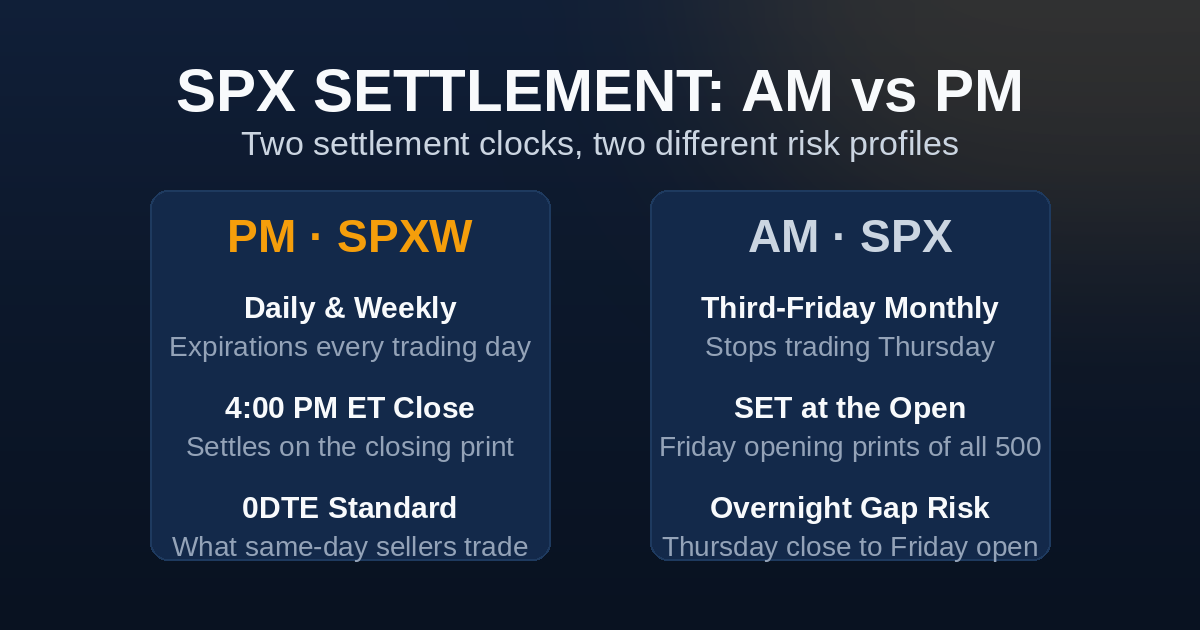
SPX options come in two settlement flavors. PM-settled contracts (ticker SPXW) — the dailies and weeklies that 0DTE traders live in — trade until 4:00 PM ET on expiration day and settle in cash against the closing SPX value. AM-settled contracts (ticker SPX) — the traditional third-Friday monthlies — stop trading Thursday afternoon and settle against SET, a value computed from Friday’s opening prints of all 500 index components. The AM structure carries one overnight session of gap risk you cannot trade out of. If you sell same-day premium, you trade the PM contracts; the AM mechanics matter mostly so they never surprise you.
What Time Do SPX Options Expire?
PM-settled SPX options (SPXW dailies and weeklies) expire at 4:00 PM ET on expiration day, settling in cash against the official closing value of the SPX index. AM-settled third-Friday monthlies stop trading at 4:00 PM ET on Thursday and settle the next morning on SET, calculated from Friday’s opening prices.
One detail trips people up: SPX options normally trade a curtailed session until 4:15 PM ET, but a contract on its own expiration day stops at 4:00 sharp. There is no 15-minute grace window on the dying contract. Whatever the index does between 4:00 and 4:15 belongs to tomorrow’s expirations, not today’s. The full schedule is in Cboe’s SPX contract specifications .
How Do SPX Options Settle?
SPX options settle in cash, never in shares. At expiration the clearing house compares the official settlement value to your strike. If the option finished in the money, the intrinsic difference times $100 moves between the buyer’s and seller’s accounts. If it finished out of the money, nothing moves and the contract disappears.
The whole sequence, in order:
- Trading stops. 4:00 PM ET on expiration day for PM-settled SPXW; 4:00 PM ET Thursday for the AM-settled monthly.
- A settlement value is fixed. The official closing SPX value for PM contracts, or Friday’s SET print for AM contracts.
- Each leg is measured against that one number. A 5600 short call versus a 5612.40 settlement is 12.40 in the money — nothing else about the day matters.
- Cash moves. 12.40 × $100 = $1,242 per contract, debited from the seller and credited to the buyer.
- The position is gone. No shares are delivered, no stock appears in the account, and nothing carries into the next session.
For a spread, every leg settles against the same value independently and the results net out. A 5600/5625 call spread settling at 5612.40 loses $1,242 on the short leg, gains nothing on the long 5625 leg (it expired OTM), and the net debit is $1,242 against whatever credit was collected at entry. There is no partial exercise and no assignment notice — the European exercise style means the only moment that ever matters is expiration.
What Time Is SPX Settlement?
Two different clocks, and the distinction is the whole point of this page. PM-settled SPXW contracts settle against the official 4:00 PM ET closing value of the index, computed the same evening — the cash typically posts to the account overnight and is visible before the next open. AM-settled SPX monthlies settle against SET, which is calculated from Friday’s opening rotation and published mid-morning, usually within the first hour or two of the session.
That publication lag is why AM-settled positions can sit in an account looking unresolved on Friday morning. The contract stopped trading Thursday, but the number that decides it doesn’t exist yet. Brokers generally show the position as pending until SET is disseminated and the clearing house applies it.
How PM Settlement Works (SPXW Dailies and Weeklies)
PM settlement is the simple one. The contract trades all day, expires with the closing bell, and settles in cash against the closing index value the same evening. In the money by 12 points? Your account is debited or credited $1,200 per contract and the position is gone. Out of the money? It expires worthless. Nothing carries overnight.

Since Cboe extended SPXW listings to every trading day of the week, there is a PM-settled contract expiring every single session — which is precisely what makes a daily 0DTE premium-selling cycle possible. You sell the morning, manage to the close, and the slate wipes clean at 4:00. The whole risk profile of a 0DTE iron condor is built on that clean same-day boundary.
How AM Settlement Works (SET and the Third-Friday Monthly)
The original SPX monthly contract — third Friday of the month, ticker SPX rather than SPXW — settles differently, and the mechanics are worth reading twice.
The contract’s last trading session ends Thursday at 4:00 PM ET, the day before expiration. Friday morning, the settlement value is calculated — not from any traded SPX price, but from the opening price of each of the 500 component stocks, whenever each happens to open. That composite is published mid-morning under the ticker SET. Because the components open at slightly different times, SET is a synthetic print: it can land at a level the index itself never actually traded through on Friday.
So an AM-settled position spends its final night frozen. You can’t close it, you can’t hedge it with the same contract, and the number that decides your P&L doesn’t exist until the next morning’s opening rotation.
The Overnight Risk Hiding in AM Settlement
Walk through what that gap can do. Say you’re short a 5600/5625 call spread in the July monthlies and SPX closes Thursday at 5560 — a comfortable 40 points out of the money. The position looks finished. Then a hot jobs number lands at 8:30 Friday morning, S&P futures rip, and the components open strong. SET prints 5618.42.
Your short call settles 18.42 in the money: a $1,842 debit per contract, on a position that was 40 points safe when you last had the ability to touch it. Nothing malfunctioned. That is simply what AM settlement is — one mandatory overnight hold with the outcome decided by an opening rotation you can’t trade against.
PM-settled contracts have their own version of expiration-day drama (a late-day move into the close), but you can watch it and act until 4:00. The AM structure takes the steering wheel away Thursday afternoon.
Which Contracts 0DTE Traders Actually Trade
PM-settled SPXW, essentially always. A same-day seller wants the contract born and settled inside one session — that’s the whole point of the trade. The AM monthlies still matter to anyone running longer-dated SPX positions (they’re deep, liquid contracts with decades of history), but for daily premium selling they’re the wrong tool, and on the third Friday of each month it pays to double-check which listing you’re actually in. Most broker chains label them clearly; the ticker (SPX vs SPXW) is the tell that never lies.
Everything else about the two listings is identical: same underlying index, same European exercise , same cash settlement , same Section 1256 tax treatment . The settlement clock is the only fork in the road.
Which Options Are AM-Settled?
AM settlement is an index-option artifact — it exists because the original monthly contracts were written before intraday index pricing was reliable, and the convention stuck. No ETF option uses it. Where the two styles sit today:
| Product | Root | Settlement | Style | Delivery |
|---|---|---|---|---|
| S&P 500 monthly | SPX | AM (SET, Friday open) | European | Cash |
| S&P 500 daily/weekly | SPXW | PM (4:00 PM close) | European | Cash |
| Mini S&P 500 | XSP | PM (4:00 PM close) | European | Cash |
| Nasdaq-100 monthly | NDX | AM (Friday open) | European | Cash |
| Nasdaq-100 weekly | NDXP | PM (4:00 PM close) | European | Cash |
| Russell 2000 monthly | RUT | AM (Friday open) | European | Cash |
| Russell 2000 weekly | RUTW | PM (4:00 PM close) | European | Cash |
| Volatility index | VIX | AM (Wednesday open) | European | Cash |
| S&P 500 ETF | SPY | PM (4:00 PM close) | American | 100 shares |
| Nasdaq-100 ETF | QQQ | PM (4:00 PM close) | American | 100 shares |
| Russell 2000 ETF | IWM | PM (4:00 PM close) | American | 100 shares |
The pattern is consistent enough to memorize: traditional third-Friday index monthlies settle AM; everything with a weekly or daily listing settles PM; every ETF option settles PM and delivers shares. A same-day seller never touches an AM contract, because a 0DTE trade by definition needs a contract that is born and settled inside one session.
VIX is the odd one out on timing — it expires on a Wednesday, 30 days before the following month’s SPX monthly expiration, and settles against a special opening quotation built from SPX option prices rather than stock prints.
Frequently Asked Questions
Is SPX cash settled?
Yes. Every SPX contract — AM or PM, monthly or daily — settles in cash. An in-the-money option produces a cash debit or credit equal to the intrinsic difference times $100 per contract. No shares are ever delivered, which is why an SPX seller can never wake up holding an unwanted stock position.
What is the SET settlement value?
SET is the special opening quotation used to settle AM-settled SPX options. It’s computed from the opening price of each of the 500 S&P components on expiration Friday and published under the ticker SET. Because components open at different moments, SET can differ noticeably from where the index appears to open.
What time do 0DTE SPX options expire?
At 4:00 PM ET on their expiration day. 0DTE trades use PM-settled SPXW contracts, which settle in cash against the official closing SPX value. The expiring contract stops trading at 4:00 even though non-expiring SPX options continue until 4:15 PM ET.
Can I exit an AM-settled SPX position on expiration Friday?
No. AM-settled monthlies stop trading Thursday at 4:00 PM ET. From that moment the position is locked, and Friday’s SET print decides the outcome. Any hedge on Friday morning has to be built from different instruments — futures or PM-settled options.
How do I tell AM and PM contracts apart?
By root ticker: SPX is the AM-settled third-Friday monthly; SPXW is the PM-settled daily/weekly. On the third Friday of a month both exist side by side, which is exactly when checking the root symbol matters most.
Related Articles
- Cash-Settled vs Physically Settled Options — what “settles in cash” actually means mechanically, and why index sellers never touch a share.
- SPX vs SPY Options: 4 Key Structural Differences — the broader comparison: settlement, exercise style, taxes, and contract size in one place.
- 0DTE Options Trading: The Complete Guide — the strategy layer that lives entirely inside the PM-settled daily cycle.
This content is for educational purposes only. Options trading involves significant risk of loss. Always trade within your risk tolerance.