30-Second Summary
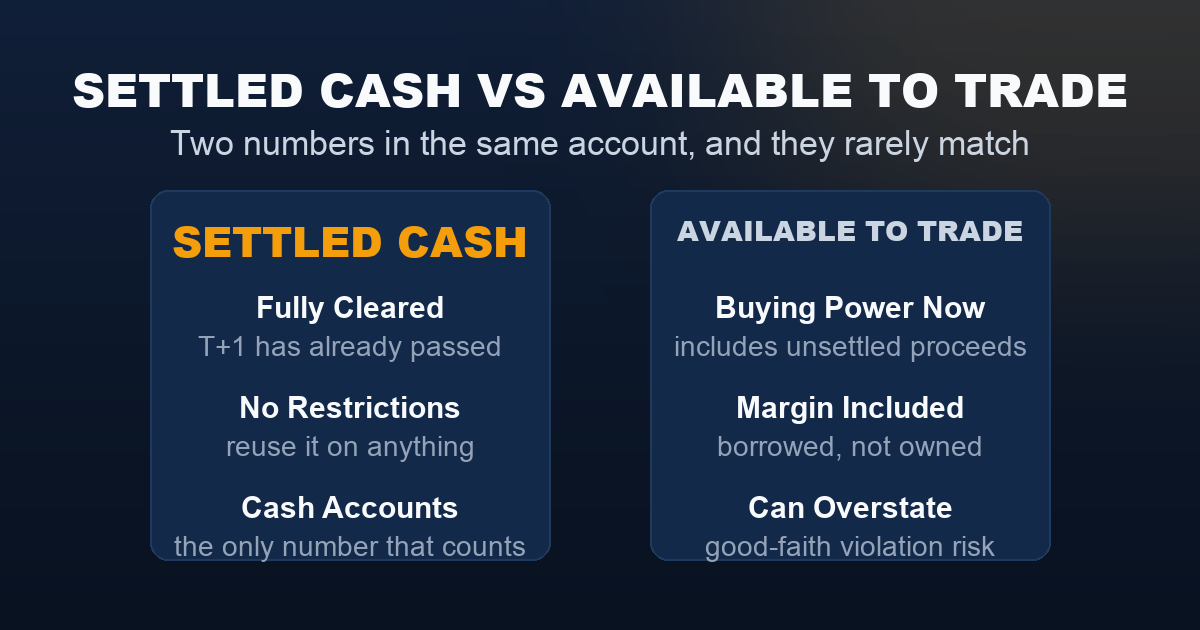
Settled cash is money that has completed the settlement cycle and carries no strings. Cash available to trade is what the broker will let you spend right now — a number that can include proceeds from trades that have not settled yet, plus margin. In a margin account the difference is mostly cosmetic. In a cash account it decides whether your next order is routine or a good-faith violation. Options settle on T+1, the business day after the trade, so premium collected on Monday is settled cash on Tuesday.
And a word of warning about vocabulary: “cash-settled” and “settled cash” have nothing to do with each other. One describes how a contract expires; the other describes the state of money in your account. More on that below.
What Does Settled Cash Mean?
Settled cash is the portion of your balance that has fully cleared the settlement process and can be used for any purchase, at any time, with no restrictions attached. It is the money the broker knows is genuinely yours, because the other side of your earlier trade has already been delivered and paid for.
Everything else in the account is in transit. Sell a contract this morning and the proceeds appear in your balance immediately, but they are unsettled until the clearing process finishes the following business day. The number is real. The freedom to redeploy it is not yet.
What Is Cash Available to Trade?
Cash available to trade is the buying power the broker will extend to you at this moment. It is a forward-looking number: it typically includes unsettled proceeds, and in a margin account it also includes the borrowing the broker is willing to do on your behalf against the securities you hold.
That makes it the larger of the two figures almost all the time, and the more optimistic one. It answers “what will the platform let me submit right now” rather than “what do I own free and clear.”
Settled Cash vs Cash Available to Trade
| Settled cash | Cash available to trade | |
|---|---|---|
| What it measures | Money that has cleared T+1 | Buying power at this instant |
| Includes unsettled proceeds | No | Usually yes |
| Includes margin | No | Yes, in a margin account |
| Restrictions on use | None | Spending it in a cash account can trigger a violation |
| When it changes | The business day after a trade | Instantly, as orders fill |
| Which one matters most | Cash accounts | Margin accounts |
The practical rule: in a cash account, treat settled cash as your real balance and ignore the larger number. In a margin account, cash available to trade is the operative figure, and the constraint moves from settlement to the pattern day trader rule instead.
How Long Do Option Trades Take to Settle?
Options settle on T+1 — the first business day after the trade date. Sell to close on Monday and the proceeds are settled cash on Tuesday. A Friday trade settles Monday, since weekends and market holidays are not business days. U.S. stocks settle on the same T+1 cycle.

One day sounds trivial until you try to trade the same capital twice in a week. A cash account running one position at a time gives up roughly a day of deployment after every exit, which is a meaningful drag on any approach built around frequent, short-duration positions.
Cash Settlement Is Not Settled Cash
These two phrases collide constantly in search results, and they describe unrelated things.
Cash settlement is a property of the contract. An in-the-money SPX option settles in cash — the intrinsic difference times $100 is debited or credited and the position disappears, with no shares delivered. It is about what arrives when a contract expires.
Settled cash is a property of your account balance. It is about when money becomes free to use, and it applies identically whether the contract that produced it was cash-settled SPX or physically-settled SPY.
An SPX position can be cash-settled at Friday’s close and the resulting money still not be settled cash until the following business day. Both statements are true at once, and they are not in conflict.
Good Faith Violations and Free Riding
Two specific mistakes come from spending the wrong balance, and both live in cash accounts.
A good faith violation happens when you buy something with unsettled funds and then sell it before those funds have settled. The broker extended you good faith that the earlier sale would clear, and you did not wait to find out. Brokers typically count these on a rolling twelve-month basis, and a pattern of them results in the account being restricted to settled cash only for 90 days.
Free riding is the harder version: buying without enough settled cash to cover the purchase, then paying for it with the proceeds of selling that very position. This one carries a 90-day restriction from the first occurrence at most brokers.
Neither is a trading loss. Both are administrative, both are avoidable by reading the smaller number, and both are invisible until the restriction lands.
Can You Trade 0DTE in a Cash Account?
Usually not in any practical sense. Two obstacles stack up. Most brokers require margin approval to sell defined-risk spreads at all, which rules out the iron condor and every vertical structure in a plain cash account. What remains is generally the fully-collateralized set — cash-secured puts and covered calls .
Then settlement finishes the argument. 0DTE trading opens and closes inside a single session by definition, so the capital from this morning’s exit is not settled cash until tomorrow. A cash account can place the trade; it cannot recycle the capital at the pace the approach assumes.
Why Margin Accounts Trade One Constraint for Another
A margin account removes the settlement wait — buying power updates as orders fill, and capital can be redeployed the same session. In exchange it brings the pattern day trader rule: an account flagged as a pattern day trader must maintain at least $25,000 in equity, and the flag comes from executing four or more day trades within five business days when those trades make up more than 6% of total trading activity.
For a same-day options approach that threshold arrives quickly. The choice is not between a constrained account and a free one — it is between a settlement constraint and a capital-minimum constraint. What also matters is the number underneath both: buying power reduction , the capital a broker sets aside while a position is open, which for a defined-risk spread is normally its maximum loss.
Frequently Asked Questions
Can I withdraw unsettled cash?
No. Funds must settle before they can be withdrawn, which is the same T+1 wait that applies to reusing them for a new position. A withdrawal request against unsettled proceeds is normally held until the settlement date rather than rejected outright.
What is the difference between cash available to trade and settled cash?
Cash available to trade is current buying power, which generally includes unsettled proceeds and, in a margin account, margin. Settled cash excludes both. The first tells you what an order screen will accept; the second tells you what you own free and clear.
Do option trades settle faster than stock trades?
No — both run on the same T+1 cycle in U.S. markets, so neither clears faster than the other. What differs is the expiration event: an index option settles in cash and ends there, while an assigned equity option leaves a stock position to manage.
Does a good faith violation apply in a margin account?
No. Good faith violations are a cash-account concept, because a margin account is not waiting on settlement to fund the next purchase. Margin accounts face the pattern day trader rule and its $25,000 equity minimum instead.
Related Articles
- Cash-Settled vs Physically Settled Options — the other meaning of settlement: what an in-the-money contract actually delivers at expiration.
- SPX AM vs PM Settlement — when SPX contracts settle and against which price, including the SET print on AM-settled monthlies.
- Options Trading Glossary — buying power reduction, fills and open interest defined alongside 37 other terms.
- 0DTE Options Trading — the approach whose capital-recycling assumptions a cash account cannot support.
- 0DTE Options: Broker Account Requirements — the other account gates: approval tiers, the PDT threshold and per-leg commissions.
This content is for educational purposes only. Nothing here is tax, legal or brokerage advice; account rules vary by broker. Options trading involves significant risk of loss.