30-Second Summary
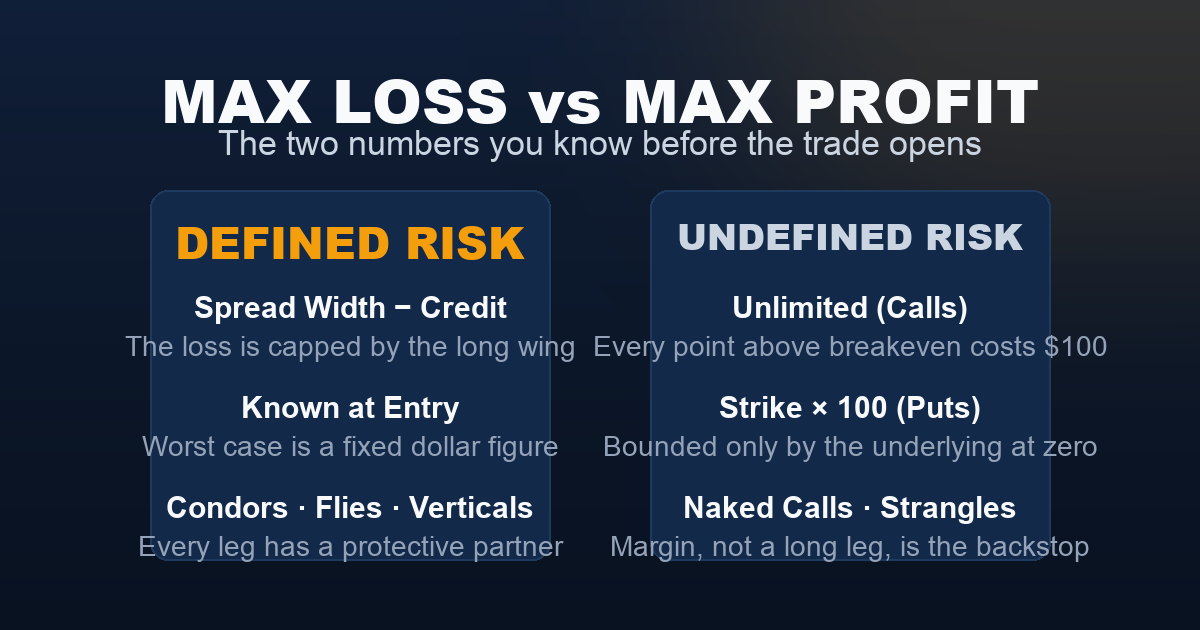
Every option position has a maximum loss and a maximum profit that are knowable at entry, before a single tick moves. For a long option, max loss is the premium paid — nothing more, ever. For a short option, max profit is the premium collected, and max loss is either unlimited (calls) or the strike times 100 minus the credit (puts). For a spread, the long leg caps everything: max loss on a credit spread is the width minus the credit, and max profit is the credit itself. Everything below is that arithmetic, applied to the thirty structures in the strategy library, with the worked SPX numbers each page uses.
What Is the Maximum Loss on a Call Option?
If you bought the call, your maximum loss is the premium you paid — full stop. A call bought for $36.00 can lose at most $3,600 per contract, and that’s the outcome if the underlying finishes at or below the strike. You cannot lose more than the debit, you can’t be assigned into a share position, and no adverse move creates an additional obligation.
If you sold the call, the answer inverts completely. A naked short call has theoretically unlimited maximum loss. There is no ceiling on how high an underlying can go, and every point above your breakeven costs another $100 per contract. Selling a 7,600 call for $21.50 caps profit at $2,150 and puts breakeven at 7,621.50 — above that, the loss just keeps counting.
The third case is the one most traders actually hold. A call spread’s maximum loss is bounded by the long leg. Short the 7,550 call and long the 7,600 against it, and the worst case is the 50-point width minus whatever credit you collected — $3,500 on a $15.00 credit, regardless of whether the underlying finishes at 7,700 or 9,000. The long call converts an unlimited liability into a fixed one, which is the entire reason defined-risk structures exist.

What Is the Maximum Loss on a Put Option?
A long put’s maximum loss is the premium paid, exactly like a long call. Buy the 7,450 put for $36.00 and $3,600 is the worst case, realized whenever the underlying finishes at or above 7,450.
A short put’s maximum loss is large but finite: (strike × 100) − credit collected. An underlying can’t go below zero, so the liability has a floor — it just happens to be a floor most accounts can’t absorb. A short 7,450 SPX put carries a theoretical worst case of $745,000 minus the credit. Nobody expects the index at zero, but the number explains why brokers hold serious margin against naked puts and why the practical risk is measured against a plausible drawdown instead. A 20% gap is the number worth sizing on, not the theoretical one.
A put spread caps it at the width. Long the 7,475 put and short the 7,425 against it for a $15.00 debit: max loss is the $1,500 debit, max profit is the $3,500 remainder of the width. Symmetric to the call case, same mechanism.
The Four Single-Leg Positions
Everything else in options is built from these four. Learn this table and most strategy math becomes assembly.
| Position | Max profit | Max loss | Breakeven |
|---|---|---|---|
| Long call | Unlimited | Premium paid | Strike + premium |
| Long put | (Strike × 100) − premium | Premium paid | Strike − premium |
| Short call (naked) | Premium collected | Unlimited | Strike + premium |
| Short put (naked) | Premium collected | (Strike × 100) − premium | Strike − premium |
The asymmetry is the whole story of option selling. A seller’s profit is capped at the credit and their loss is not — which sounds like a terrible trade until you weigh it by probability. The seller wins most of the time by design; the buyer wins rarely and large. Neither side is free money, and the structural case for selling rests on that distribution, not on any individual outcome.
Max Loss and Max Profit for Every Strategy
Worked numbers below come from each strategy page’s own SPX or SPY example, so the arithmetic is traceable — click through for the full setup.
Defined-risk credit strategies
You collect a credit at entry. Max profit is that credit; max loss is the width minus the credit.
| Strategy | Max profit | Max loss | Worked example |
|---|---|---|---|
| Bull Put Spread | Net credit | (Width − credit) × 100 | +$1,500 / −$3,500 |
| Bear Call Spread | Net credit | (Width − credit) × 100 | +$1,500 / −$3,500 |
| Iron Condor | Net credit | (Width − credit) × 100 | +$1,700 / −$3,300 |
| Iron Butterfly | Net credit (pin at body) | (Wing width − credit) × 100 | +$5,000 / −$5,000 |
| Short Butterfly | Net credit (beyond wings) | (Wing width − credit) × 100 | +$1,200 / −$3,800 |
| Jade Lizard | Net credit | Downside only: (put strike × 100) − credit | +$5,500 / large downside |
The jade lizard is the interesting one: by collecting a credit larger than the call spread’s width, the upside loss is engineered to zero. All the risk sits below the short put.
Defined-risk debit strategies
You pay a debit at entry. Max loss is that debit; max profit is the width minus the debit.
| Strategy | Max profit | Max loss | Worked example |
|---|---|---|---|
| Bull Call Spread | (Width − debit) × 100 | Net debit | +$3,500 / −$1,500 |
| Bear Put Spread | (Width − debit) × 100 | Net debit | +$3,500 / −$1,500 |
| Long Iron Condor | (Width − debit) × 100 | Net debit | +$3,300 / −$1,700 |
| Long Iron Butterfly | (Wing width − debit) × 100 | Net debit | +$5,000 / −$5,000 |
| Long Butterfly | (Wing width − debit) × 100 | Net debit | +$3,800 / −$1,200 |
Undefined-risk strategies
No long leg. Margin is the only backstop, and the max-loss column is why these demand real position sizing.
| Strategy | Max profit | Max loss | Worked example |
|---|---|---|---|
| Short Put (Naked) | Premium collected | (Strike × 100) − premium | +$500 / −$51,000 theoretical |
| Naked Short Call | Premium collected | Unlimited | +$2,150 / unlimited |
| Short Straddle | Both premiums (pin at strike) | Unlimited upside | +$7,200 / unlimited |
| Short Strangle | Both premiums (between strikes) | Unlimited both sides | +$4,300 / unlimited |
| Call Ratio Spread | Credit + spread width | Unlimited above the short strikes | +$5,800 / unlimited |
Long-volatility strategies
You pay for the right to be right about a big move. Loss is capped, profit is not.
| Strategy | Max profit | Max loss | Worked example |
|---|---|---|---|
| Long Straddle | Unlimited (up), very large (down) | Both premiums, at the strike | −$5,000 max loss |
| Long Strangle | Unlimited (up), very large (down) | Both premiums, between strikes | −$4,300 max loss |
| Call Back Spread | Unlimited above upper breakeven | (Width × 100) + debit, at the long strike | −$5,500 max loss |
| Long Call | Unlimited | Premium paid | −$3,600 max loss |
| Long Put | (Strike × 100) − premium | Premium paid | −$3,600 max loss |
Stock-based and time-based strategies
Max loss here includes the share position, which changes the arithmetic entirely.
| Strategy | Max profit | Max loss | Worked example |
|---|---|---|---|
| Covered Call | (Strike − cost basis + premium) × 100 | (Cost basis − premium) × 100 | +$1,700 / stock to zero |
| Cash-Secured Put | Premium collected | (Strike × 100) − premium | +$700 / −$73,800 |
| Protective Put | Unlimited (stock upside) | (Cost basis − strike) × 100 + premium | −$1,700 floor |
| Collar | (Call strike − basis) × 100 | (Basis − put strike) × 100 | +$1,000 / −$1,000 |
| The Wheel | Premiums + share appreciation | Stock to zero, less premiums collected | Cycle-dependent |
| Long Calendar Spread | Approx. at the strike, IV-dependent | Net debit | ~+$2,850 / ~−$2,850 |
| Short Calendar Spread | Approx. on a large move | Approx. net credit at the strike | ~+$2,850 / ~−$2,850 |
| Diagonal Spread | Near the short strike at near-term expiry | Net debit paid | −$9,300 debit |
| PMCC | Short-call credits + LEAPS gain to the strike | LEAPS debit paid | Debit-dependent |
Calendars and diagonals are the honest asterisk in this table. Their payoff at the near-term expiration depends on the implied volatility of the back month, which isn’t known in advance — so max profit is an estimate, not an identity. Every other row is arithmetic.
How to Calculate Breakeven
Breakeven is where the position’s P&L crosses zero at expiration. Three patterns cover almost everything:
- Single long option: strike ± premium. Calls add, puts subtract.
- Credit spread: short strike ± credit. A bull put spread with a 7,475 short put and $15.00 credit breaks even at 7,460.
- Debit spread: long strike ± debit. A bull call spread long the 7,525 with a $15.00 debit breaks even at 7,540.
Two-sided structures have two breakevens, one per side. An iron condor collecting $17.00 with short strikes at 7,450 and 7,550 breaks even at 7,433 and 7,567 — and the distance between those two numbers is the actual width of the winning range, which is a far more useful figure than the distance between the short strikes.
Defined Risk vs Undefined Risk
The distinction isn’t about how much you can lose. It’s about whether the number exists before the trade does.
A defined-risk position has a worst case you can write on paper at entry: spread width minus credit, times 100, times contracts. It doesn’t change if the market gaps 200 points overnight. Whatever happens, the long leg is there, and the loss stops where the width stops.
An undefined-risk position has no such wall. The loss is whatever the market decides to do, bounded only by zero on the downside and by nothing at all on the upside. That’s survivable with disciplined sizing and genuinely dangerous without it — the difference between a short strangle on 1% of the account and the same strangle on 20% isn’t a matter of degree.
Both approaches make money. Undefined-risk selling collects more premium per unit of margin, and for a well-capitalized account that’s a real edge. But the tail is not theoretical: 2018’s volatility spike and 2020’s March gap both produced losses that exceeded years of accumulated credits for sellers who sized against normal conditions rather than abnormal ones.
Max Loss Is Not a Position Size
Here’s where the table above stops being enough. Knowing that an iron condor’s max loss is $3,300 tells you the worst case on one contract. It says nothing about how many you should hold.
A rule-based seller sizes against the max loss across the entire position, not per contract, and typically well below it. Ten condors at $3,300 max loss each is $33,000 of theoretical exposure — on a $100,000 account, a third of the account riding on one day’s range. Most systematic approaches cap total defined risk far lower than that, because the whole premise of selling premium is surviving to collect it repeatedly. A single max-loss day that removes a third of the capital removes most of the compounding too.
The other half of the answer is that max loss is rarely realized. A mechanical stop exits long before a spread goes fully in the money. On that same $17.00 credit, a rule that closes the position when it costs $34.00 to buy back caps the realized loss near $1,700 per contract — roughly half the $3,300 theoretical maximum, and it triggers hours before expiration decides anything. The max-loss column is a boundary condition, not an expectation. Size against it; plan around the stop.
Frequently Asked Questions
What is the maximum loss on a long call?
The premium paid, and nothing more. A call purchased for $36.00 loses at most $3,600 per contract, realized when the underlying finishes at or below the strike at expiration. The buyer has a right, not an obligation, so there is no scenario that creates additional liability.
Can you lose more than you invest with options?
Only if you sell them. Long options cap the loss at the debit paid. Short naked options can lose far more than the credit collected — unlimited on calls, up to strike × 100 on puts. Defined-risk spreads sit in between: the loss can exceed the credit, but never exceeds the spread width.
What is the max loss on an iron condor?
Spread width minus net credit, times 100. A condor with 50-point wings collecting $17.00 has a max loss of ($50 − $17) × 100 = $3,300 per contract. Only one side can lose — the underlying cannot finish above the call spread and below the put spread simultaneously.
What is the max profit on a credit spread?
The net credit collected at entry. A bull put spread taking in $15.00 makes at most $1,500 per contract, realized when both legs expire out of the money. No favorable move produces more than the credit — that ceiling is what you accept in exchange for the higher probability of reaching it.
Is max loss the same as margin requirement?
For defined-risk spreads, usually yes — brokers typically hold the max loss as buying power, since that’s the largest possible obligation. For naked positions there is no max loss to hold, so brokers apply a formula based on the underlying’s price and volatility, and that requirement moves against you as the position goes wrong.
Related Articles
- Options Payoff Diagrams: All 30 Strategies — the same information as pictures; every max-loss number in this table is the flat line on one of those charts.
- Iron Condor: Payoff, Max Loss & How to Trade It — the defined-risk structure the 0DTE approach is built on, with the width-minus-credit math worked in full.
- Option Selling and Its Advantages — why a capped max profit paired with a larger max loss is still the favorable side of the trade over a long enough sample.
- Options Strategies Library — all thirty pages, organized by difficulty, each with its own payoff diagram and worked example.
This content is for educational purposes only. Options trading involves significant risk of loss. Always trade within your risk tolerance.