Slippage is the variable tax on a 0DTE iron condor — it scales with the spread and the speed of the tape. Commission is the other tax, and it behaves differently. It’s flat, it’s certain, and it lands the same whether the market is calm or violent. You pay it to open and you pay it to close, every single trade, forever.
On a high-frequency, small-credit strategy like 0DTE condor selling, a fixed per-trade cost is not a rounding error. It’s a structural drag that compounds across hundreds of trades a year. This page walks through exactly how much.
The assumption used here: $10 in total commission to open and close one 1-lot iron condor — roughly $5 each way across the four legs. If your broker bills you $10 per side (so $20 round trip), double every figure below. If you pay per-contract, the dollars scale with size but the percentages hold.
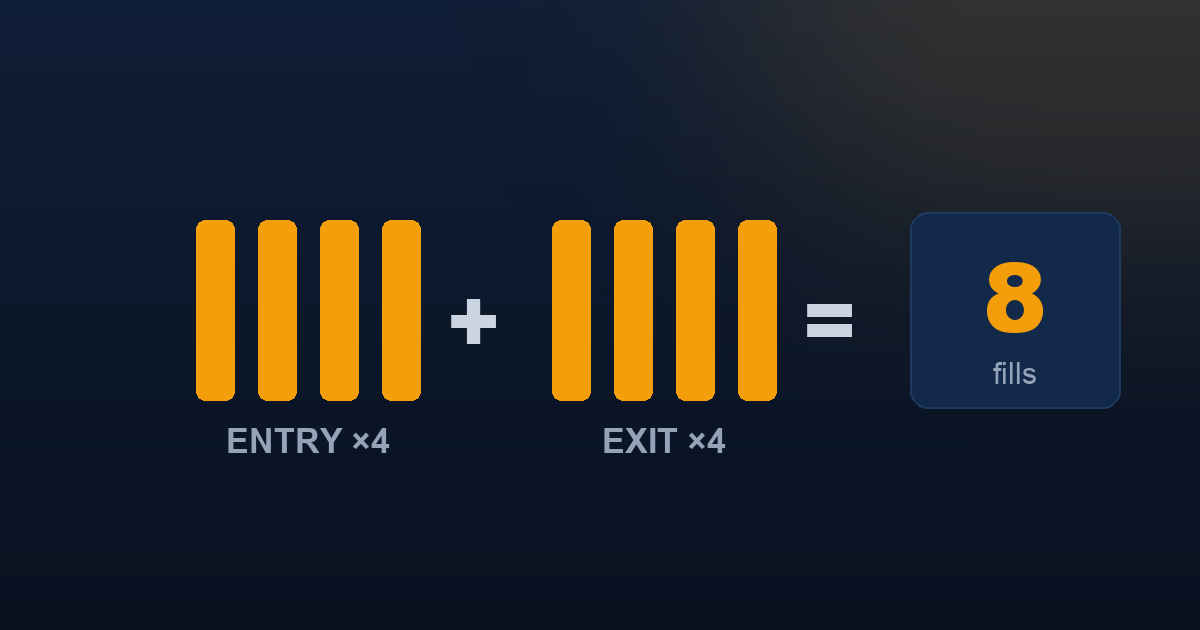
An Iron Condor Pays Commission Eight Times
A single short option is one leg in and one leg out — two commissionable events. An iron condor is four legs:
- Sell OTM call
- Buy further OTM call (wing)
- Sell OTM put
- Buy further OTM put (wing)
Open the structure and that’s four fills. Close it and that’s four more. Eight commissionable legs per complete round trip. Even at a modest per-leg rate, eight of them add up, and unlike slippage you can’t work the order to avoid it. The fee is the fee.
The Per-Trade Bite
Take a representative SPX iron condor: sold for a $2.30 credit ($230 on a 1-lot), managed to a 50% profit target.
| Amount | |
|---|---|
| Gross credit captured (50% of $230) | $115.00 |
| Commission (round trip) | -$10.00 |
| Net captured | $105.00 |
Ten dollars on a $115 gross capture is 8.7% of the profit gone to commission — on a winning trade. On a smaller credit it’s worse. Sell a tighter condor for $1.50 and target 50%, and the same $10 eats 13% of the $75 you were trying to keep. The fee is fixed, so the smaller the credit, the larger the share it takes.
That’s the part that catches people: commission doesn’t care how good the trade was. A $10 fee on a great fill and a $10 fee on a mediocre one cost exactly the same.
How It Compounds Over a Year
0DTE has a fresh expiration every trading day — roughly 250 trading days a year. Run one condor a day and you’ve paid for 250 round trips.
| Per trade | Per year (250 trades) | |
|---|---|---|
| Gross P&L before costs (illustrative) | $40 | $10,000 |
| Commission | $10 | $2,500 |
| Net P&L | $30 | $7,500 |
| Commission as % of gross | 25% | 25% |
(The $40 average is illustrative — a blend of profit-target winners and the occasional stop-out loss. Your real number depends on win rate and sizing. The point is the relationship, not the exact figure.)
A quarter of the gross edge, gone — not to a bad market, not to a wrong call, but to the flat cost of transacting. And that’s at the friendly $10-round-trip assumption. At $20 round trip, the commission line becomes $5,000 and swallows half the gross.
This is the difference between a fixed cost and a variable one. Slippage hurts more when the market is fast. Commission hurts always, in exact proportion to how often you trade. For a strategy whose entire design is high frequency, that’s the expensive combination.
Why Sizing Up Doesn’t Save You
A natural instinct is “I’ll just trade bigger and the commission won’t matter.” With per-contract pricing, that doesn’t work the way you’d hope.
| Size | Commission / round trip | Gross credit (50% PT) | Commission % |
|---|---|---|---|
| 1 lot | $10 | $115 | 8.7% |
| 5 lots | $50 | $575 | 8.7% |
| 10 lots | $100 | $1,150 | 8.7% |
Per-contract commissions scale right alongside the credit, so the percentage drag is roughly constant no matter how large you go. You don’t grow out of it. The levers that actually move the number are different:
- Trade less often. Fewer round trips, less total commission. Directly at odds with the “trade every eligible day” logic of a distribution strategy, so it’s a real trade-off, not a free win.
- Capture more credit per trade. A wider or closer-to-the-money condor collects more premium, diluting the fixed eight-leg cost. It also carries more risk — nothing is free.
- Skip the exit commission entirely. This one is SPX-specific, and it’s the most interesting.
The SPX Expiration Lever
SPX options are European-style and cash-settled. If the condor finishes inside your short strikes at the close, all four legs expire worthless. There’s nothing to buy back — no closing trade, no exit commission, no assignment, no exercise fees. You keep the full credit and pay commission on the entry only, roughly halving the round-trip cost.
That sounds like free money until you remember why most systems close early. Holding a 0DTE condor into the final bell means riding peak gamma all the way to settlement. A quiet afternoon that turns at 3:50 PM can convert a comfortable winner into a loss with no time to react. The 50% profit target exists precisely to take that gamma risk off the table.
So the lever is real but it has a price tag in risk:
- Close at the profit target: pay the full round-trip commission, but cap gamma exposure.
- Let winners expire in the zone: save the exit commission, but hold the tail risk into the close.
There’s no universally correct answer. It’s a deliberate trade between a known cost (commission) and an uncertain one (a late reversal). Knowing the two are linked is what lets you choose on purpose instead of by default.
Commission and Slippage Together
Neither cost lives alone. Every trade pays both: the bid/ask give-up on the fill and the flat commission on top. Stack them on the $2.30 condor at a 50% target:
| Cost | Amount | Share of $115 gross |
|---|---|---|
| Slippage (entry + exit) | ~$12 | ~10% |
| Commission (round trip) | $10 | ~9% |
| Total friction | ~$22 | ~19% |
Close to a fifth of the captured premium gone before the trade has been judged on its merits. Across a year of daily trading, frictional cost is one of the largest single line items standing between the strategy’s gross edge and what actually lands in the account.
The Bottom Line
Commission is the most predictable cost in trading and, for that reason, the easiest to ignore. It never spikes, never surprises, never shows up in a dramatic drawdown. It just quietly removes the same slice from every trade, eight legs at a time, two hundred and fifty times a year.
The fix isn’t to fear it — it’s to count it. Model your edge after commission and slippage, not before, and size and trade frequency to the net number. The traders who last aren’t the ones who found a market with no costs. They’re the ones who knew exactly what their costs were and built the strategy to clear them.
→ Read next: Slippage in 0DTE Options Trading | 0DTE Options Trading: The Complete Guide | Options Greeks — Complete Guide
This content is for educational purposes only. Options trading involves significant risk of loss. 0DTE options carry elevated intraday risk due to gamma. Commission and fee structures vary by broker. Past performance is not indicative of future results. Consult a qualified financial professional before trading.