What Are Options Greeks?
Options Greeks are mathematical sensitivities. Each one measures how an option’s price responds to a specific change in market conditions — the underlying price, time passing, implied volatility, or interest rates.
Greeks don’t predict where prices will go. They describe the exposure an option position carries right now, and how that exposure will change as conditions evolve. Understanding them is understanding why an option behaves the way it does: why a call gains value when the stock rallies, why premium erodes daily even when the underlying doesn’t move, why a VIX spike affects some positions far more than others.
Every option position has a Greek profile. That profile shifts continuously as the underlying moves, time passes, and market conditions change.
The Five Primary Greeks
| Greek | Symbol | Measures | Long Call | Long Put |
|---|---|---|---|---|
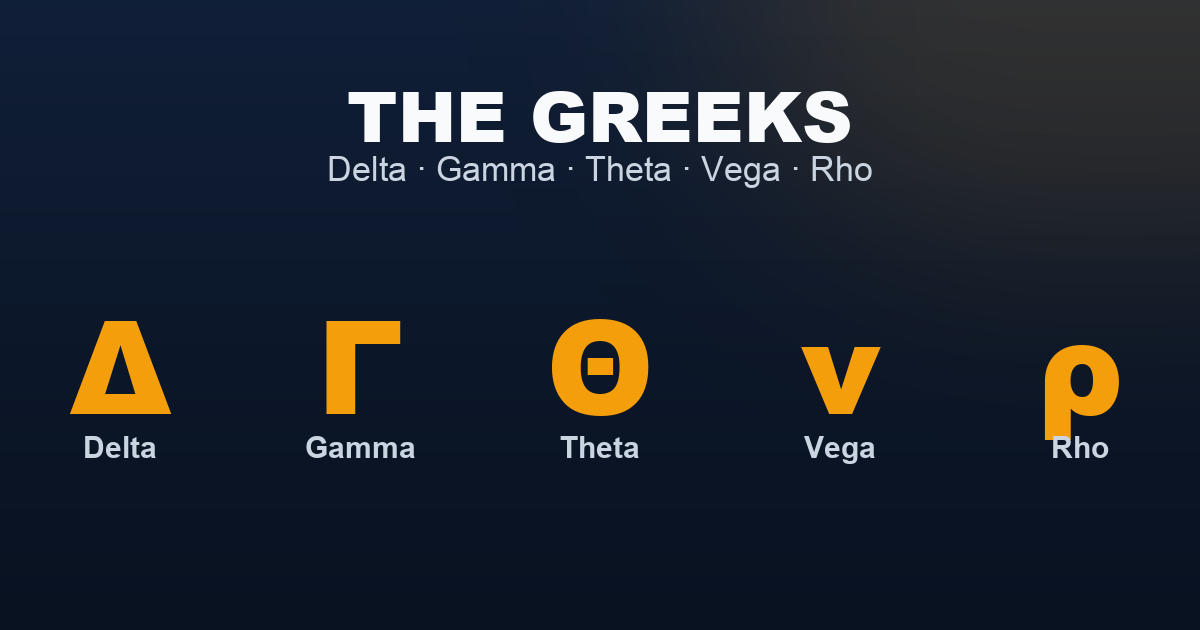
| Delta | Δ | Price change per $1 underlying move | Positive (0 to +1) | Negative (−1 to 0) |
| Gamma | Γ | Delta change per $1 underlying move | Positive | Positive |
| Theta | Θ | Price change per day elapsed | Negative | Negative |
| Vega | ν | Price change per 1-point IV move | Positive | Positive |
| Rho | ρ | Price change per 1% interest rate move | Positive | Negative |
Three things to notice immediately:
- Gamma, Theta, and Vega have the same sign for calls and puts. Buying any option — call or put — gives you positive gamma, negative theta, and positive vega. Selling any option reverses all three.
- Delta is the only Greek with opposite signs for calls vs puts. Calls are long delta; puts are short delta.
- Theta and Gamma are always at odds. Long options collect positive gamma (benefit from large moves) and pay negative theta (erode daily). Short options collect positive theta and suffer negative gamma.
How Time to Expiry Changes Everything
The most practically important concept in options pricing: the same Greek has a completely different magnitude — and sometimes a different character — depending on how much time remains until expiration.
Four expiration categories are worth understanding distinctly:
- 0DTE — same-day expiry; options expire at market close (or the following morning for AM-settled contracts)
- Near-term — 1 to 14 days to expiry
- Mid-term — 30 to 90 days to expiry
- LEAPs — 1 to 3 years to expiry
| Greek | 0DTE | Near-Term (1–14 DTE) | Mid-Term (30–90 DTE) | LEAPs (1–3 yr) |
|---|---|---|---|---|
| Delta | Near-binary at ATM — swings 0→1 on small moves | Elevated sensitivity near strike | Stable; ATM ≈ 0.50 throughout day | Deep ITM approaches 1.0; far OTM stays near 0 but with genuine probability |
| Gamma | Extreme spike at ATM — the dominant risk | High, especially near ATM | Moderate; delta changes gradually | Very low; delta barely responds to underlying moves |
| Theta | Maximum — all remaining time value erodes in one session | Rapid, especially in final 2 days | Moderate and steady daily decay | Tiny daily loss; vast total time value that takes years to decay |
| Vega | Near zero — IV changes barely affect the price | Low to moderate | Significant — IV events change position value materially | Very high — position value is primarily an IV exposure |
| Rho | Effectively zero — rates cannot change intraday | Negligible | Small but measurable if rates change during hold | Significant — Fed rate cycles affect LEAP pricing noticeably |
The pattern across expiries: 0DTE is dominated by Gamma and Theta. LEAPs are dominated by Vega and Rho. Delta is important at every expiry, but behaves very differently across the spectrum.
The Greeks in Depth
Delta (Δ)
The directional sensitivity of an option. A call with delta 0.50 gains approximately $0.50 for every $1 the underlying rises. At 0DTE, delta near the strike becomes nearly binary — rapidly approaching either 0 or 1 as expiry draws close.
Gamma (Γ)
The rate at which delta changes. Gamma is the hidden accelerator — it explains why 0DTE positions can shift from comfortable to critical in minutes on a trending move, and why LEAPs barely respond even to large underlying swings.
Theta (Θ)
The daily cost of holding an option. Time value erodes every day, and the erosion accelerates as expiry approaches. A 0DTE option loses its entire remaining time value in a single session. A 2-year LEAP barely notices one additional day of passing time.
Vega (ν)
The sensitivity to implied volatility. A 5-point VIX move can have almost no effect on a 0DTE option and a dramatic effect on a LEAP. Vega is why events like Federal Reserve announcements matter far more for longer-dated positions than for same-day expiries.
Rho (ρ)
The sensitivity to interest rates. Effectively irrelevant for 0DTE and near-term options — interest rates cannot change within a trading session. Becomes meaningful for mid-term positions during active rate cycles. Significant for LEAPs, where multi-year rate moves affect option pricing materially.
Second-Order Greeks
Beyond the five primaries, options have second-order sensitivities that describe how the primary Greeks themselves change:
| Name | Measures |
|---|---|
| Charm (delta decay) | How delta changes as time passes |
| Vanna | How delta changes when IV changes |
| Vomma | How vega changes when IV changes |
| Speed | How gamma changes when the underlying moves |
Second-order Greeks are used primarily by market makers and institutional hedgers who manage large options books. For most purposes, mastering the five primary Greeks provides a complete picture of an option position’s behaviour.
How the Greeks Interact
Greeks don’t operate in isolation. A large underlying move changes delta (via Gamma). An IV spike changes all Greeks simultaneously. Time passing changes delta (Charm), gamma, theta, and vega simultaneously.
The most important relationship: Gamma and Theta are always in opposition. Long options carry positive gamma (you benefit from large moves) but pay negative theta (you lose value each day without movement). Short options collect positive theta but suffer negative gamma (large moves hurt). Every options position balances these two forces.
The secondary relationship: Vega and Theta move in opposite directions with DTE. Longer-dated options carry more vega (high IV exposure) and less theta (slow daily decay). Shorter-dated options carry more theta (rapid decay) and less vega (IV barely moves the needle). Choosing an expiration is partly a choice about which risk you prefer to carry.
Greeks in Context
The Greek framework shows up across everything the site covers. A few starting points:
- Introduction to Options Trading — how calls, puts, and Greeks fit together as the foundation of options pricing
- Option Selling and Its Advantages — why positive theta and short vega create a structural edge for premium sellers
- 0DTE Options Trading: The Complete Guide — how extreme gamma and accelerated theta define the same-day expiration game
- 0DTE Iron Condor: The Strategy and the Rules — delta selection, gamma risk, and theta capture applied as a daily mechanical system
- Strategies Hub — all options strategies, each with its own Greek profile across entry, hold, and exit
This content is for educational purposes only.