30-Second Summary
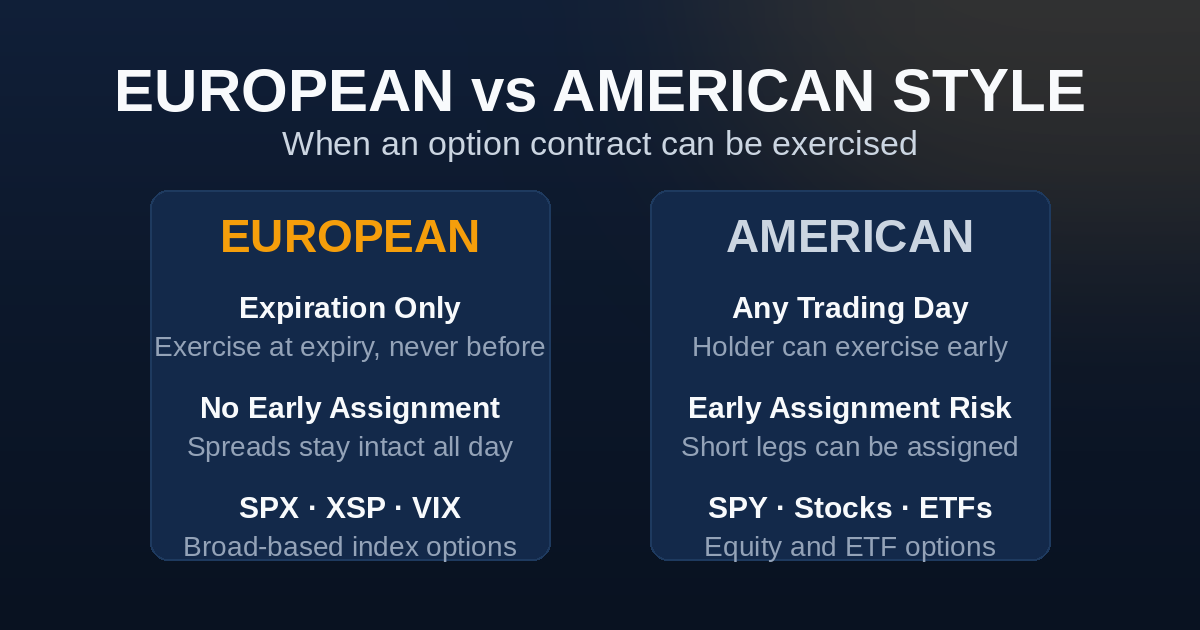
Exercise style answers a single question: when can the option’s owner exercise it? European-style options can be exercised only at expiration. American-style options can be exercised on any trading day up to and including expiration. That one difference creates early assignment — the risk that a short American-style option gets converted into a stock position before expiration, breaking apart whatever spread it belonged to. SPX, XSP, and VIX options are European. SPY, single stocks, and nearly all ETF options are American. For an option seller, this is the quiet reason index products feel structurally calmer than their ETF twins.
What Is Exercise Style?
Exercise style is the contract term that decides when an option’s holder is allowed to exercise it. There are exactly two, set by the contract specification and never negotiable: European exercise style permits exercise only at expiration, and American exercise style permits it on any trading day. Nothing else about the option changes.
It is one of the four structural specs that define any listed contract, alongside settlement type (cash or shares), settlement timing (AM or PM), and contract size. You don’t choose the exercise style — you choose the product, and the product carries it. Every SPX contract ever listed is European. Every SPY contract ever listed is American.
What Is European Exercise Style?
A European-style option can be exercised only at its expiration, never before. The holder can buy or sell the contract freely all through its life, but the right it contains — to settle against the underlying — activates at expiry alone. For sellers, that means early assignment is structurally impossible.
Nothing about the name is geographic. “European” options trade all day in Chicago; the label is old market shorthand for the exercise convention and nothing more. SPX options are European-style by contract design — it’s stated plainly in Cboe’s SPX specifications — as are XSP , VIX, NDX, and RUT options.
What Is American Exercise Style?
An American-style option can be exercised by its holder on any trading day during the contract’s life. SPY options, single-stock options, and almost all ETF options are American-style. The flexibility belongs entirely to the buyer; for the seller it appears on the other side of the ledger as assignment risk that exists from the first minute of the trade.

“European” Doesn’t Mean You’re Locked In
A misconception worth killing early: European style restricts exercise, not trading. You can open and close a European-style option any time the market is open — buy it back, roll it, take profit at 10:15 AM on a contract that expires at 4:00 PM. A 0DTE iron condor on SPX gets closed intraday thousands of times a day across the market. The only thing that waits for expiration is the exercise mechanism itself.
If you sell premium, that’s the best of both worlds. You keep every exit you’d ever use — and lose only the one event you never wanted: someone else exercising into you early.
What Is Early Assignment?
Early assignment is what the seller experiences when the holder of an American-style option exercises before expiration. The Options Clearing Corporation (OCC ) receives the exercise notice and allocates it among brokers whose customers are short that contract; the broker then assigns it to a specific short position, typically at random. The seller wakes up to a stock position — long shares if short a put, short shares if short a call — at the strike price, effective immediately.
You don’t get a vote, and you usually find out after the fact.
When Does Early Assignment Actually Happen?
Rationally, almost never — an option holder who exercises early throws away whatever time value the contract still has, so most of the time selling the option beats exercising it. Early assignment concentrates in two specific situations:
Deep in-the-money puts with little time value left. Once a put’s extrinsic value drops near zero, exercising early lets the holder collect the strike price in cash today rather than at expiration. The deeper ITM and the closer to expiry, the higher the odds.
Calls the day before an ex-dividend date. If the dividend is worth more than the call’s remaining time value, exercising the call to capture the dividend is free money for the holder. Short calls on dividend-paying stocks and ETFs get assigned in waves the night before ex-div dates. SPY goes ex-dividend quarterly, and every one of those dates is an assignment event for somebody.
Notice what’s on that list: dividends and deep-ITM economics. Not randomness, not malice. Early assignment is rare, predictable in aggregate — and still capable of wrecking a specific spread on a specific night.
Why Option Sellers Prefer European Style
The problem isn’t the assignment itself. It’s what assignment does to a structure.
Take a defined-risk bull put spread on SPY: short the 550 put, long the 545 put. The two legs are a package — the long put caps the short put’s downside, and the margin requirement reflects the pair. Now SPY breaks lower and your short 550 put goes deep ITM. A holder exercises. You’re assigned: 100 shares of SPY land in your account at $550 — a $55,000 stock position — while your long 545 put sits there unexercised. Overnight, your defined-risk spread has become long stock plus a put, with gap exposure and possibly a margin call if the account can’t carry the shares.
The defined-risk box you built got opened from the outside.
On SPX, this sequence cannot start. European exercise means the short leg stays a short leg until expiration, the spread stays a spread, and max loss stays the number you computed at entry — all the way to cash settlement . That structural quiet, stacked with Section 1256 taxes , is most of the answer to “why do index sellers bother with SPX?” — the case laid out in full in SPX vs SPY Options .
Which Products Use Which Style
| Product | Exercise style | Settlement |
|---|---|---|
| SPX / SPXW options | European | Cash |
| XSP (Mini-SPX) | European | Cash |
| VIX options | European | Cash |
| NDX, RUT options | European | Cash |
| SPY, QQQ, IWM options | American | Shares |
| Single-stock options | American | Shares |
The pairing isn’t a coincidence: broad-based index options are European and cash-settled because there’s no deliverable basket a retail account could reasonably take delivery of. One notable exception proves the style is a design choice, not a law of nature — OEX (S&P 100) options are cash-settled but American-style, a 1980s legacy structure that modern index products deliberately moved away from.
Frequently Asked Questions
Can SPX options be assigned early?
No. SPX options are European-style, so exercise can occur only at expiration. A short SPX position can lose money before expiry — exercise style doesn’t change the P&L math — but it can never be converted into an assigned position mid-trade. Spreads keep their defined-risk structure for their entire life.
Can you sell or close a European-style option before expiration?
Yes, freely. European style only restricts exercise. Buying to close, selling to open, rolling, taking profit intraday — all normal. Most 0DTE SPX positions are opened and closed the same day without expiration ever entering the picture.
Why would anyone exercise an option early?
Only when exercising is worth more than selling: a call the day before an ex-dividend date when the dividend exceeds remaining time value, or a deep in-the-money put with almost no time value left. Outside those cases, early exercise burns time value the holder could have sold.
How do I know if I’ve been assigned?
Your broker notifies you after processing, usually overnight — the shares (or short shares) appear in the account before the market reopens. That timing is exactly the problem: the position exists for hours before you can do anything about it.
Related Articles
- Cash-Settled vs Physically Settled Options — the sibling concept: what actually changes hands when exercise finally does happen.
- SPX vs SPY Options: 4 Key Structural Differences — exercise style is one of four structural gaps between the index and the ETF; the other three live here.
- 0DTE Iron Condor on SPX: The Strategy and the Rules — the defined-risk structure whose integrity depends on the short legs staying short.
This content is for educational purposes only. Options trading involves significant risk of loss. Always trade within your risk tolerance.