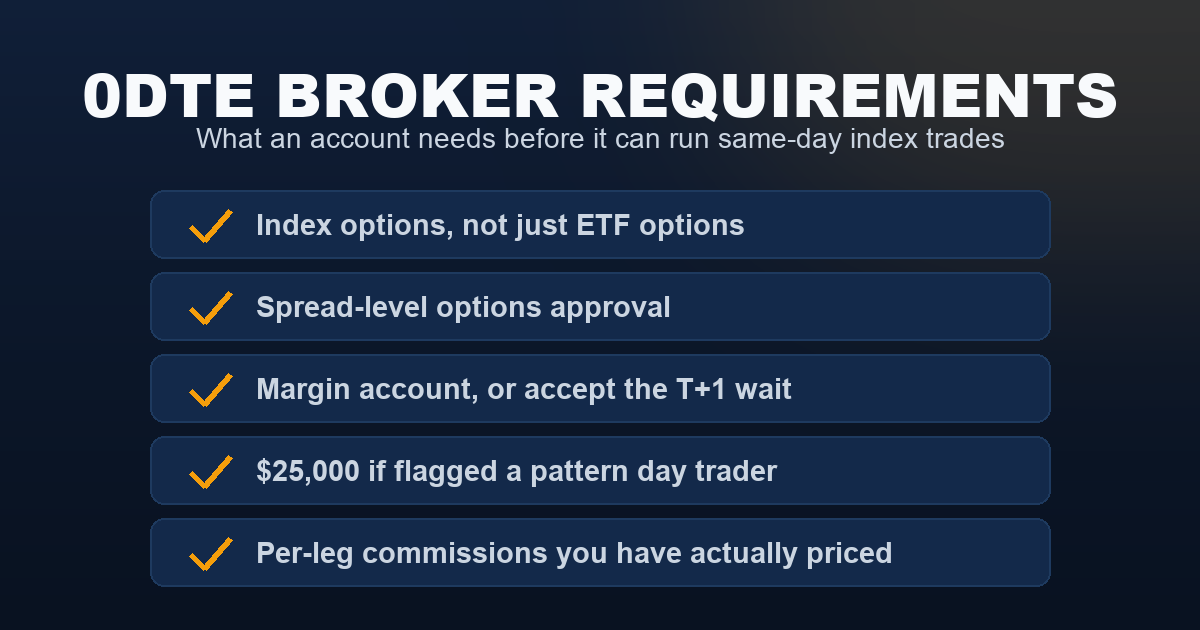
30-Second Summary
Most U.S. brokers that offer options can technically support 0DTE SPX trades, but the account itself has to clear several gates first — and the gate that stops people is almost always options approval level, not the platform. Selling a defined-risk spread requires spread-level permission; a plain long-options account cannot place the order at all. Beyond that, the account type decides whether capital can be recycled the same session, the pattern day trader rule sets a $25,000 floor for frequent same-day trading, and commissions land on every leg separately.
This page covers the requirements themselves, not a broker league table. Fee schedules, tier names and platform features change constantly — the structural questions below do not.
Can You Trade 0DTE Options at Any Broker?
No. Two filters remove a meaningful share of accounts before strategy ever comes into it. The broker must list index options — some platforms carry ETF options only, which means SPY but no SPX. And the account must hold approval for spreads if the plan involves anything with more than one leg.
An account that clears both can trade 0DTE. An account missing either cannot, regardless of balance or experience.

1. Index Options, Not Just ETF Options
SPX and its daily SPXW series are index options, a different product class from options on an ETF like SPY. A broker can offer a deep options platform and still not carry index products, and some app-first brokers fall into exactly that category.
The distinction matters beyond availability. Index options are cash-settled and European-style , so no shares are ever delivered and no position can be assigned early. They also fall under Section 1256 tax treatment . An account restricted to ETF options gets none of that — see SPX vs SPY for what changes.
2. What Options Approval Level Do You Need?
Selling defined-risk spreads generally requires the third tier of options approval at most brokers — the one that permits spreads. Covered calls and cash-secured puts usually sit at the lowest tier, long calls and puts at the second, spreads at the third, and naked short options at the highest.
The numbering is not standardized. One firm’s “Level 3” is another’s “Tier 2” or “Advanced,” and the exact contents of each tier vary. What is consistent is the ladder underneath the names: collateralized short positions → long options → defined-risk spreads → undefined risk. An iron condor sits on the spreads rung, which is the practical requirement for most 0DTE premium selling.
Approval is granted on the application, based on stated experience, income and objectives. Upgrading usually means resubmitting that form rather than opening a new account.
3. Cash Account or Margin Account
A cash account can hold fully collateralized positions, but it generally cannot sell spreads at all, and option proceeds take a business day to become settled cash . Since 0DTE opens and closes inside one session, the capital from this morning’s exit is not free until tomorrow — which defeats the point of a same-day approach.
A margin account removes the settlement wait. It also introduces the next requirement.
4. The Pattern Day Trader Threshold
An account flagged as a pattern day trader must maintain at least $25,000 in equity. The flag applies to margin accounts executing four or more day trades within five business days when those trades exceed 6% of total trading activity. Opening and closing the same 0DTE position in one session is a day trade by definition, so a daily approach reaches the threshold in a week.
Below $25,000, the account is restricted from further day trading until equity is restored. This is a regulatory floor, not a broker preference, and it is the single most common surprise for a new same-day trader.
5. Commissions Are Charged Per Leg
Index options are rarely commission-free, and the charge applies per contract, per leg. A four-legged iron condor pays on four legs entering and four leaving — eight charges per round trip . At a typical per-contract rate, that overhead consumes a real share of the credit on a small position.
Two structural questions are worth asking before funding an account: whether index options carry a different rate from equity options, and whether closing trades priced below a small threshold are exempt. Both change the arithmetic on high-frequency, small-credit trades far more than the headline rate does.
6. Native Multi-Leg Order Handling
A four-legged structure should be submitted as one order with one net price. Platforms that make you leg in separately expose the position to the market between fills and hand you the bid-ask spread four times instead of once — the mechanism behind most avoidable slippage .
Worth checking: whether the platform supports native four-leg orders on index products, whether it routes at a net credit or debit limit, and whether it can close the whole structure as a unit rather than leg by leg.
7. Expiration-Day Mechanics
Same-day positions live and die inside one session, so the platform’s expiration handling stops being a footnote.
PM-settled SPXW contracts stop trading at 4:00 PM ET on their expiration day and settle in cash against the closing index value. Non-expiring SPX series continue in a curtailed session until 4:15 PM ET — the dying contract gets no such window. Any position still open at 4:00 settles automatically at whatever the close produces; SPX AM vs PM settlement covers both clocks in full.
Brokers also differ on auto-liquidation: whether the platform closes positions on its own when margin thresholds are breached late in the session, and at what time. That behavior is worth knowing before it happens rather than during.
Why Broker-Specific Answers Go Stale
Commission schedules, tier names, platform capabilities and index-product availability all change, sometimes several times a year. Any page listing what a named broker charged for a 0DTE index contract is one pricing update away from being wrong, and a reader who acts on stale numbers is worse off than one who checks.
The requirements above are structural — they come from the product, the exchange and the regulator, not from a broker’s marketing. Use them as the question list, and confirm the specifics directly against the broker’s current documentation before funding anything.
Frequently Asked Questions
What options approval level do you need for an iron condor?
The spread tier — commonly the third of four levels, though the naming differs by firm. Any defined-risk multi-leg structure sits there. Covered calls and cash-secured puts usually sit lower, and naked short options require the highest tier available.
Can you trade 0DTE options in a cash account?
In practice, no. Most brokers require margin approval to sell spreads, and option proceeds settle T+1, so capital from today’s exit cannot be reused until the next business day. A cash account can hold fully collateralized positions but cannot support same-day recycling.
Do you need $25,000 to trade 0DTE options?
Only if the account is flagged as a pattern day trader, which happens after four or more day trades in five business days in a margin account. A single 0DTE position opened and closed the same day is a day trade, so a daily approach hits the threshold quickly.
Are SPX options available at every broker?
No. SPX and SPXW are index options, a separate product class from ETF options, and not every platform carries them. An account limited to ETF options can trade SPY but not SPX, which forfeits cash settlement, European exercise and Section 1256 treatment.
Why do 0DTE trades cost more in commissions than they look?
Because the charge is per contract, per leg, on both entry and exit. A one-lot iron condor generates eight commission events per round trip, so the cost scales with leg count rather than with position size or credit collected.
Related Articles
- 0DTE Options Trading — the mechanics an approved account is there to execute: entry timing, strike selection and exit rules.
- Iron Condor Commission Costs — the eight-charge round trip worked through in dollars across a year of trades.
- Settled Cash vs Cash Available to Trade — why a cash account cannot redeploy this morning’s proceeds this afternoon.
- SPX vs SPY Options — what an account restricted to ETF options gives up on settlement, exercise and tax treatment.
This content is for educational purposes only and is not brokerage, tax or legal advice. Account rules, approval tiers and fee schedules vary by broker and change over time — confirm current terms directly with yours. Options trading involves significant risk of loss.